
Wingstop MenuPrices & Calories 2026
All 46 items with current estimated prices, full calorie counts and honest ordering notes. Know what it costs and what it does before you reach the counter.
Searches item names and descriptions — results update as you type.
Updated August 12, 2026Typical U.S. prices — franchises set their own.
Most searched item
Small 6pc Boneless Combo
Six boneless wings in up to two flavours, one dip, a regular seasoned fries or veggie sticks and a 20oz soft drink. This is the entry point to the whole menu and the order most first-time customers should place: two flavours means you get to compare a dry rub against a wet sauce in a single sitting, which is the fastest way to work out what you actually like.
- 46
- Menu items
- 9
- Categories
- $1.49
- Items from
46 items on the menu
Individual Combos
6 items
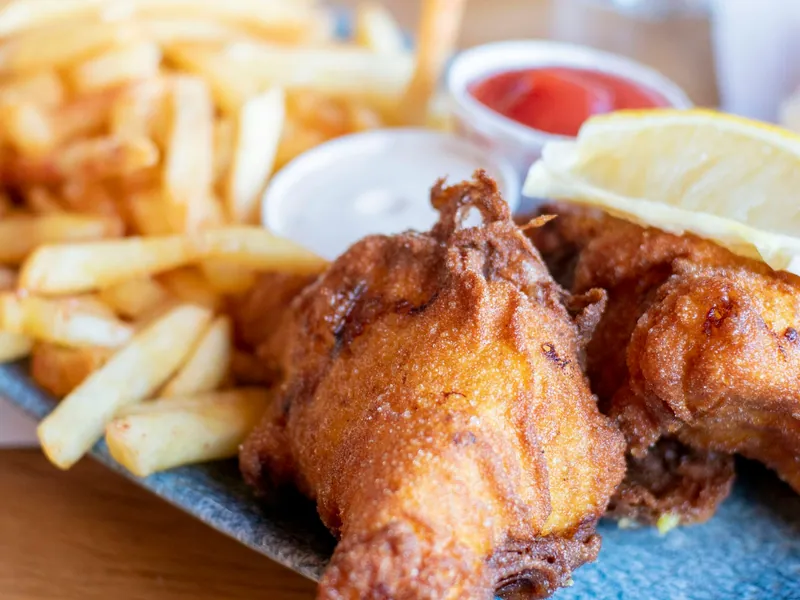
Small 6pc Boneless Combo
Six boneless wings in up to two flavours, one dip, a regular seasoned fries or veggie sticks and a 20oz soft drink. This is the entry point to the whole menu and the order most first-time customers should place: two flavours means you get to compare a dry rub against a wet sauce in a single sitting, which is the fastest way to work out what you actually like. The wings alone are 707 calories; the full combo with fries and a drink comes to 1,779. At $9.49 it is the cheapest complete meal on the board, and the two-flavour split costs nothing extra.
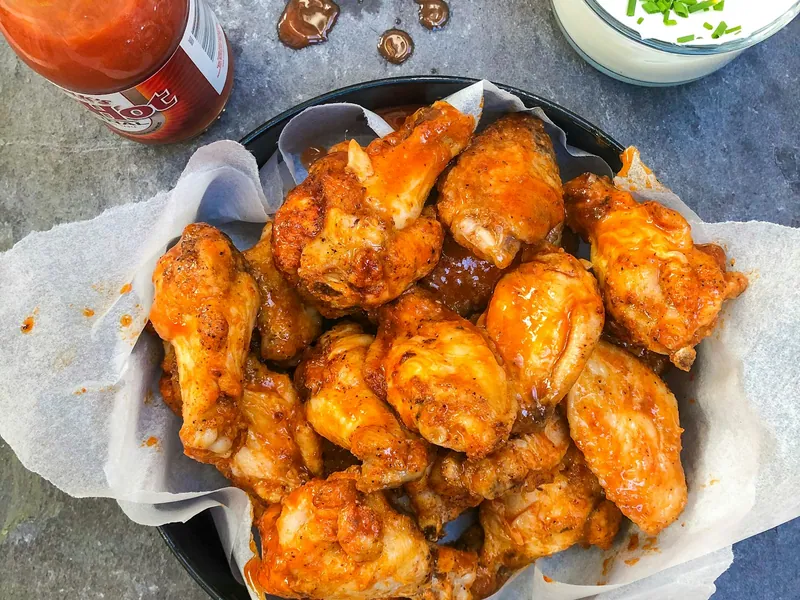
Small 6pc Bone-In Combo
The same combo built on classic bone-in wings — six pieces, two flavours, one dip, fries or veggie sticks, and a 20oz drink. Eighty cents more than the boneless version and thirty calories higher on the wings alone at 737, though the full combo lands at 1,809. The bone-in wings carry sauce and dry rub better because skin holds seasoning in a way breading does not, and the meat stays moister against the bone. If you care about the wings rather than the convenience, this is the version to order.
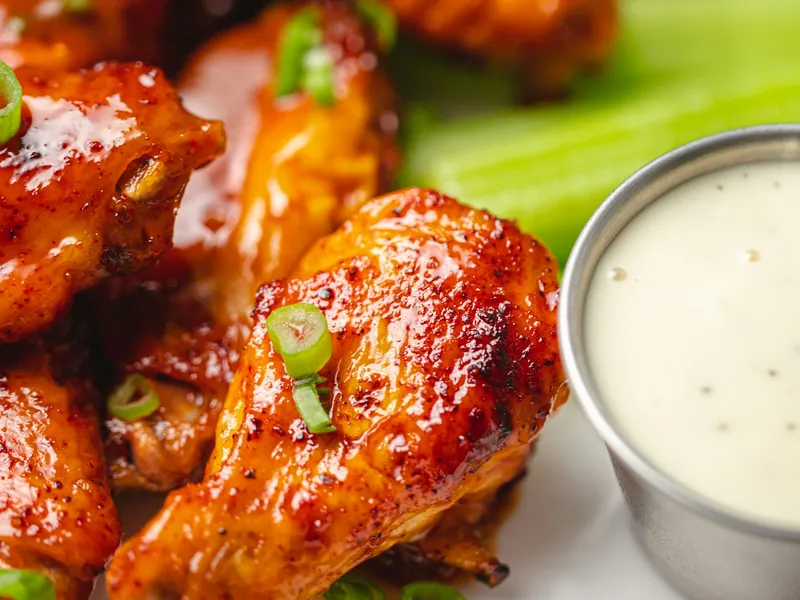
Medium 8pc Boneless Combo
Eight boneless wings with two flavours, one dip, fries or veggie sticks and a 20oz soft drink. The step up from the 6pc adds two wings for $1.80, which is a worse per-wing rate than the jump to the 10pc — this is the awkward middle of the combo range. Wings alone are 857 calories and the full combo reaches 1,949. Worth ordering if six is genuinely not enough and ten is genuinely too many, which is a narrower band than most people think.
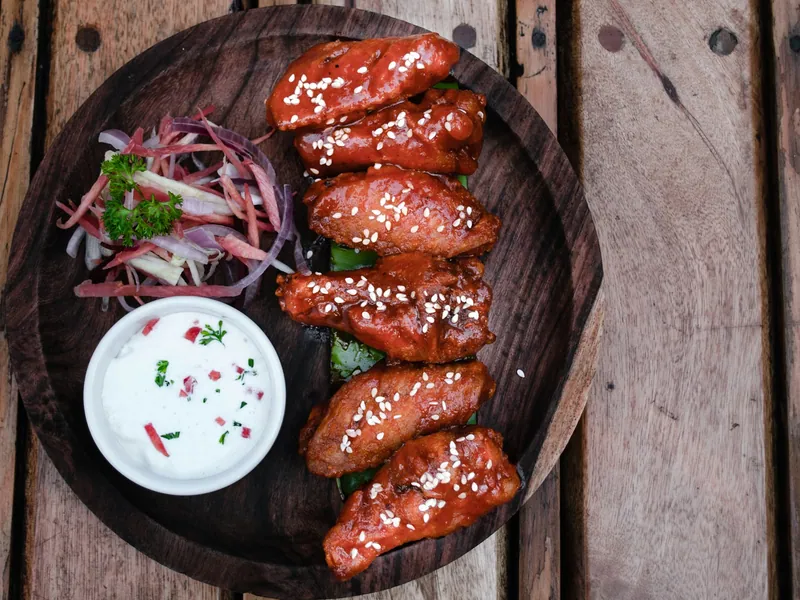
Medium 8pc Bone-In Combo
Eight classic bone-in wings, two flavours, one dip, a side and a 20oz drink. At 877 calories for the wings and 1,969 for the complete combo, it sits between the small and large in every respect including value. Because bone-in pieces vary in size more than boneless do, an 8pc bone-in order can feel noticeably larger or smaller than the last one — that is the nature of a real wing rather than a portioned piece of breast meat.
Large 10pc Boneless Combo
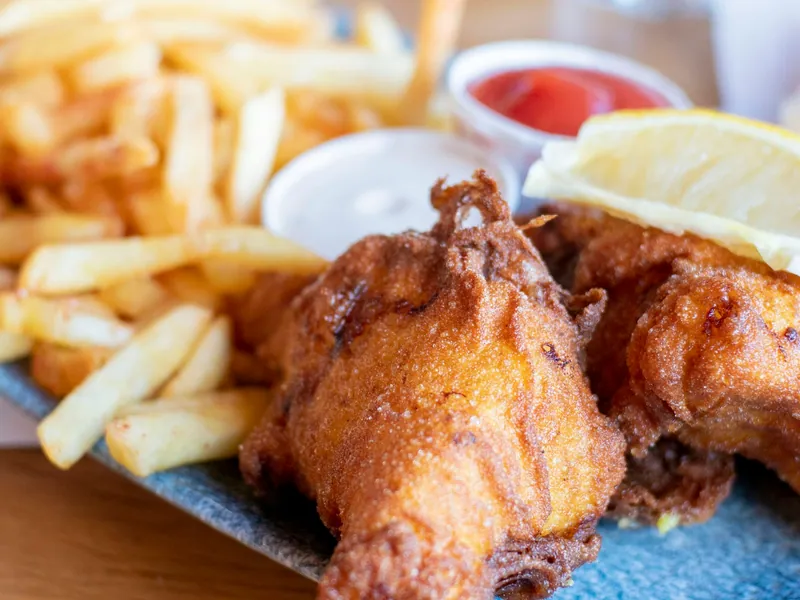
Ten boneless wings across two flavours with a dip, fries or veggie sticks and a 20oz soft drink. This is the best per-wing value in the individual combo range: only a dollar more than the 8pc for two extra wings. The wings alone are 1,117 calories and the full combo comes to 2,190, which is the largest single-person order on the board and genuinely more food than most people need in one sitting. Ordering this and taking two wings home is common and entirely sensible.
Large 10pc Bone-In Combo
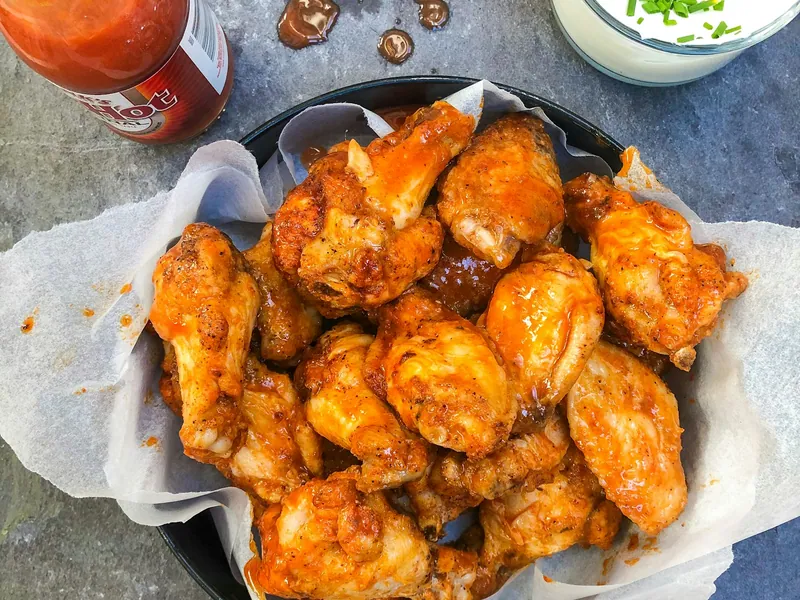
Ten classic bone-in wings, two flavours, one dip, a side and a drink. Note the calorie figure: at 1,017 for the wings it is a hundred calories BELOW the boneless version of the same count, because boneless are breaded breast meat and classic wings are not. That is the single most misread fact on this menu. The full combo lands at 2,160. At $13.19 this is the most expensive individual combo and the one that gives you the most actual wing.
Wings By the Piece
10 items
10pc Boneless Wings
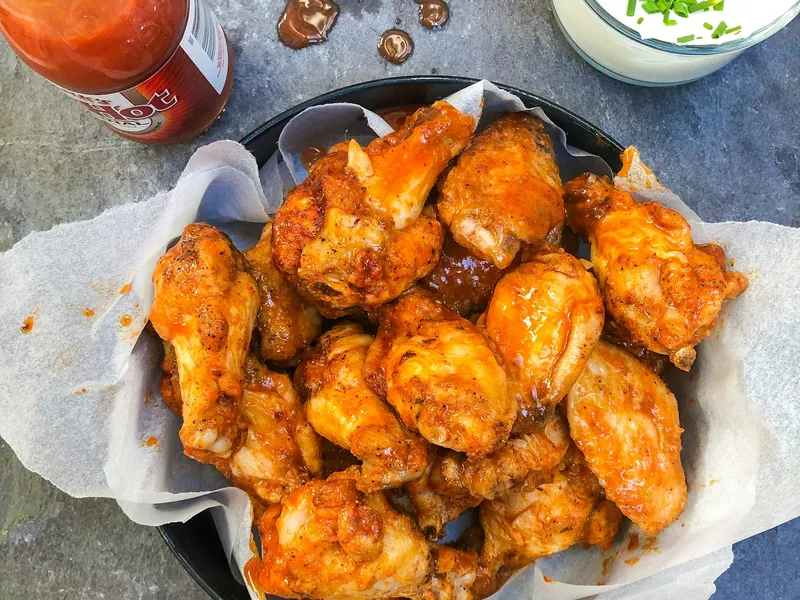
Ten boneless wings split across up to two flavours, no sides and no drink. At $8.39 this is cheaper than the 6pc combo despite carrying four more wings, which tells you exactly what the combo is charging you for — the fries and the drink. If you are eating at home and have both already, ordering by the piece is meaningfully better value. Eight hundred calories for the wings, and the flavour you choose barely moves that figure.
10pc Bone-In Wings
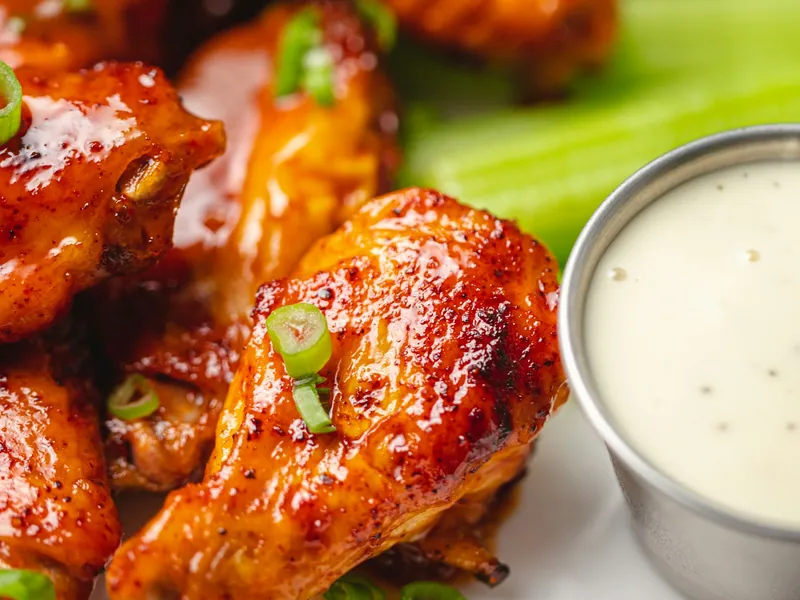
Ten classic bone-in wings across up to two flavours. A dollar-ten more than boneless and a hundred calories lower at 700, which is the pattern across every count on this board. This is the order for someone who wants to taste what the kitchen actually does — skin, fry and seasoning, with nothing bundled around it. Two flavours at this count is included, so there is no reason to order ten of one thing unless you want to.
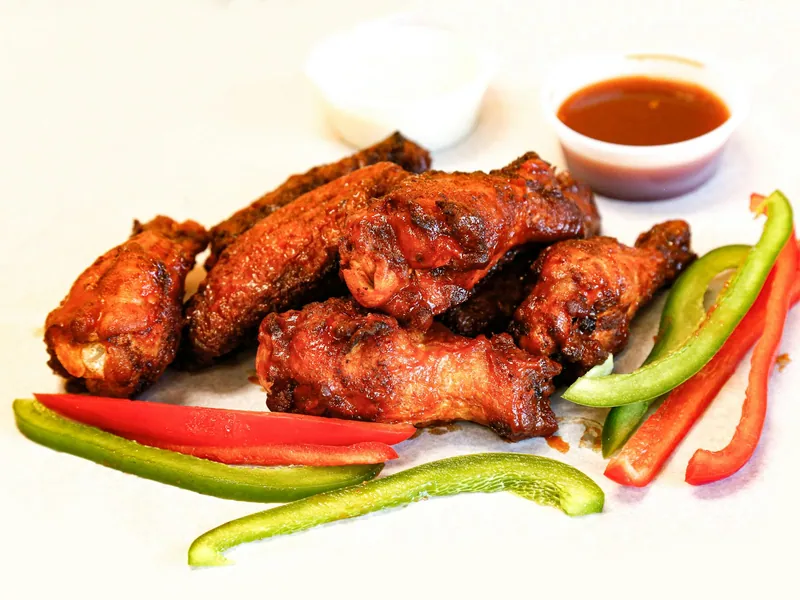
20pc Boneless Wings
Twenty boneless wings across up to three flavours. The per-wing rate improves against the 10pc and the flavour allowance rises to three, which makes this the smallest order that genuinely works for a group with divided opinions. At 1,600 calories it is a substantial amount of food — realistically two to three people rather than one. The three-flavour split is the feature here and it costs nothing.
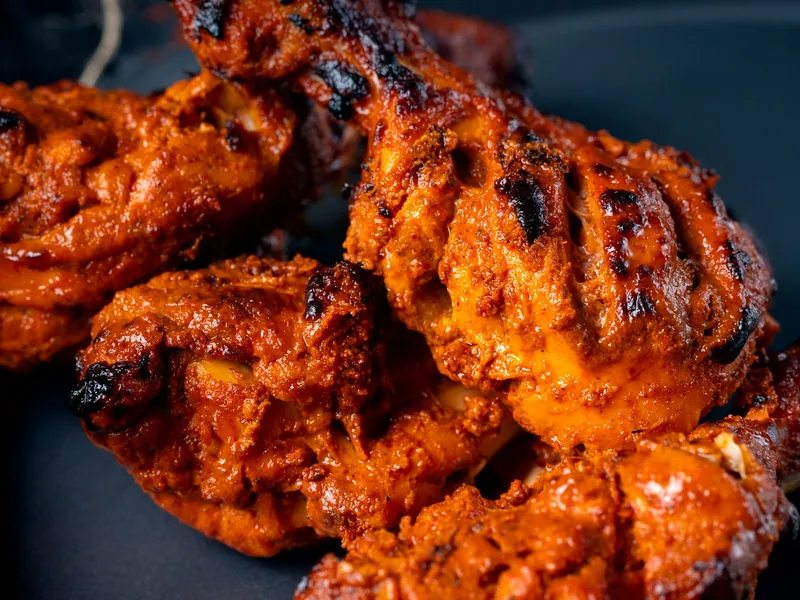
20pc Bone-In Wings
Twenty classic wings across up to three flavours, at 1,400 calories. Two hundred calories below the boneless equivalent and $1.70 more. This is the count where ordering bone-in starts making obvious sense: you get three flavours, enough wings to share properly, and the skin-on pieces hold their sauce better across the time it takes a group to work through twenty of them.
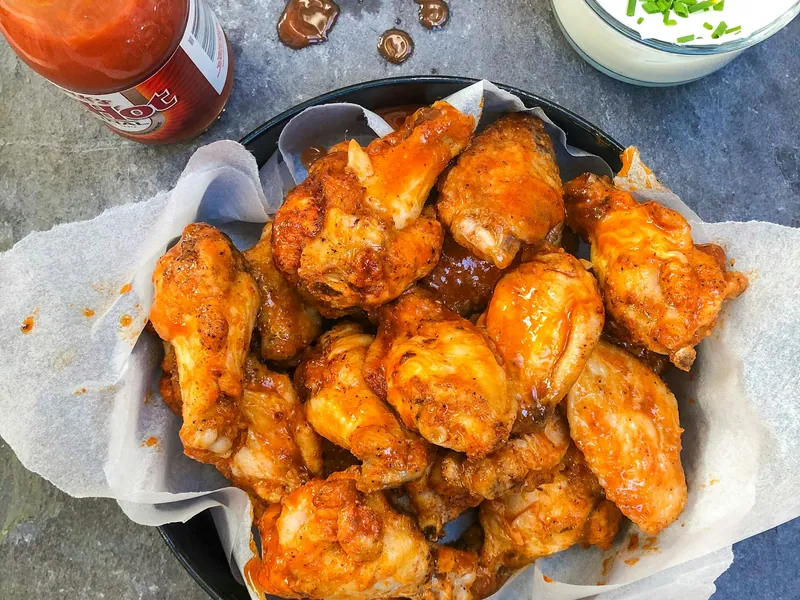
30pc Boneless Wings
Thirty boneless wings across up to three flavours, 2,400 calories. The per-wing rate continues to fall — this works out below the 20pc rate and well below the 10pc. For four people this is the sensible wing quantity, though you will want to add fries and dips separately since nothing is bundled. Worth comparing against the Crew Pack, which includes large fries, veggie sticks and three dips for a few dollars more.
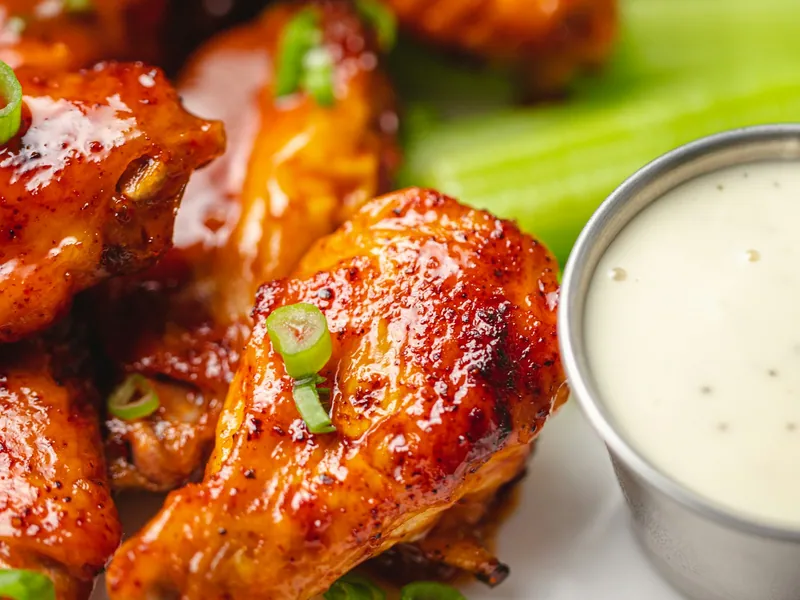
30pc Bone-In Wings
Thirty classic wings across up to three flavours at 2,100 calories. Three hundred calories under the boneless version. At this count the flavour split matters most — three flavours across thirty wings gives ten of each, which is enough of any one thing that nobody at the table has to fight for the last of the good one.
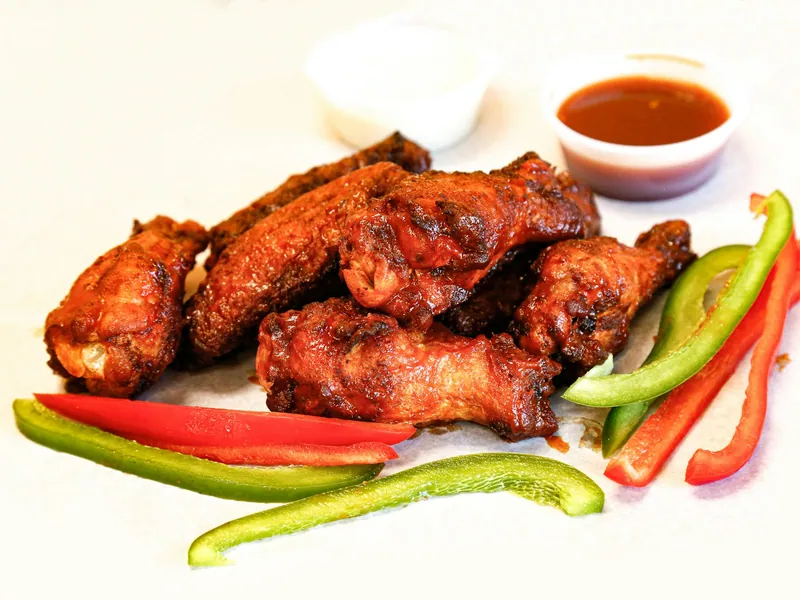
50pc Boneless Wings
Fifty boneless wings across up to four flavours, 4,000 calories. A party quantity rather than a dinner quantity, and priced accordingly at roughly eighty cents a wing — the best rate on the board short of the 100pc. Four flavours across fifty is the right ratio for a mixed group. Order this with enough notice; fifty wings cooked to order is a real amount of fryer time.
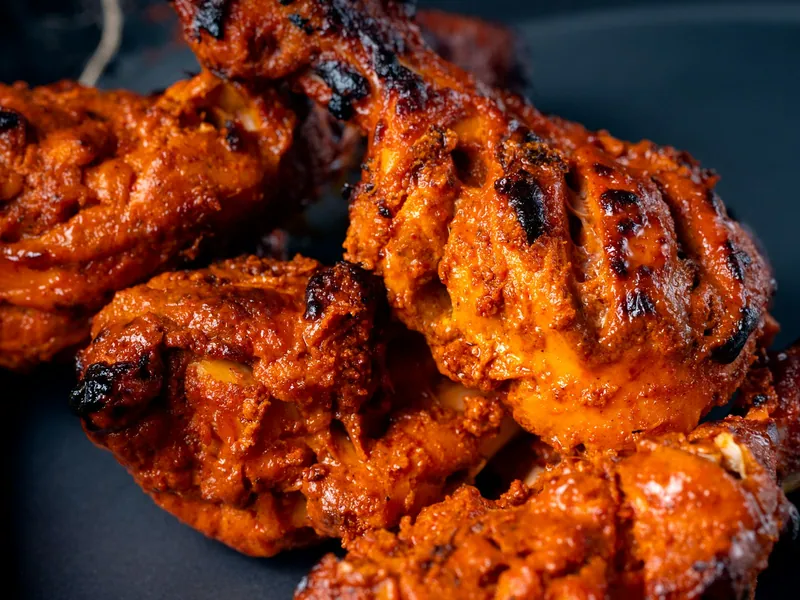
50pc Bone-In Wings
Fifty classic wings across up to four flavours at 3,500 calories — five hundred below the boneless equivalent. For a gathering of eight to ten this is the correct order, and the four-flavour allowance means you can cover the whole heat range from Atomic down to Garlic Parmesan in a single box.
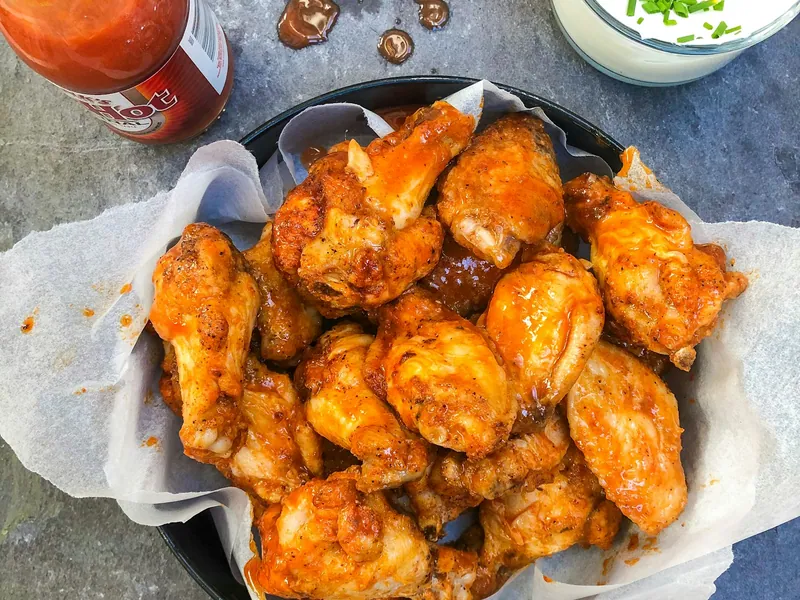
100pc Boneless Wings
One hundred boneless wings across up to six flavours, 8,000 calories. The largest order on the menu and the best per-wing rate available. Six flavours is enough to cover the entire board, which makes this genuinely practical for a large party rather than just a big number. Ring ahead — this is not an order to place at a counter on a Friday evening and expect quickly.
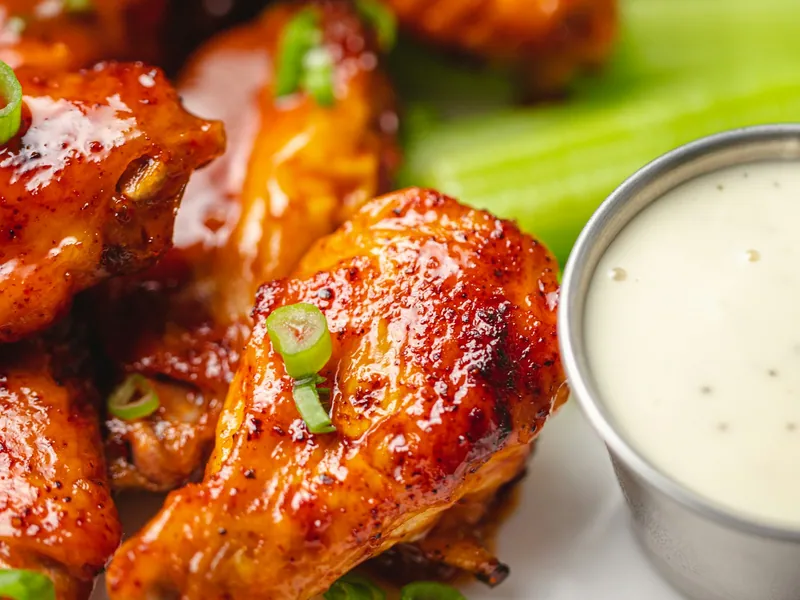
100pc Bone-In Wings
One hundred classic wings across up to six flavours, 7,000 calories. A thousand calories below the boneless hundred and ten dollars more. This is a catering order in everything but name and it should be treated like one: order well in advance, plan the six flavours deliberately rather than at the counter, and add large fries and dips to match.
Group Packs
8 items
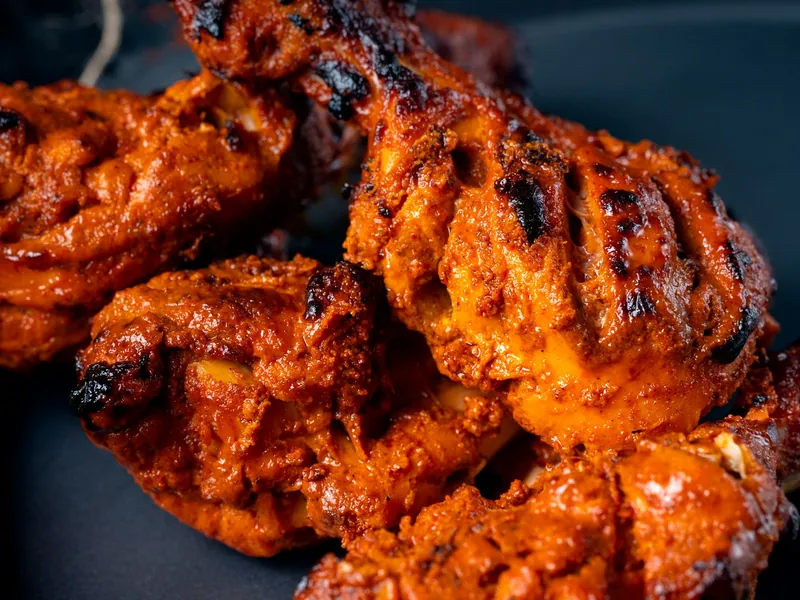
Meal for 2 — Boneless
Fifteen boneless wings in two flavours with two dips, a large seasoned fries or veggie sticks and two 20oz soft drinks. Priced at $20.29, which works out at just over ten dollars a head for a complete meal including drinks. The wings alone are 1,829 calories and the full pack reaches 3,710 across two people. This is the cleanest two-person order on the menu — everything is included and nothing needs adding.
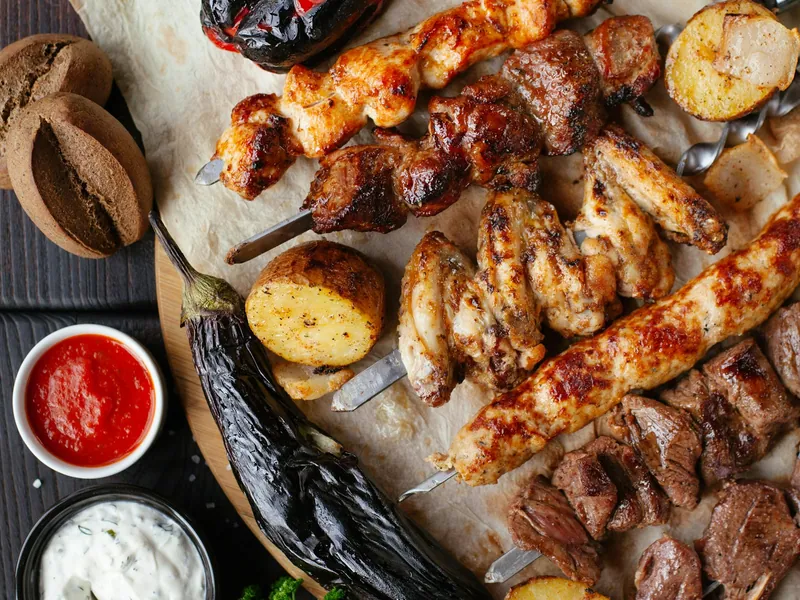
Meal for 2 — Bone-In
Fifteen classic wings in two flavours, two dips, a large side and two soft drinks at $21.99. The wings are 1,619 calories — two hundred and ten fewer than the boneless version — and the complete pack is 3,560. Fifteen bone-in wings between two people is a genuine meal rather than a light one, and the two-dip allocation is correct rather than mean, which is not always true of bundled dips.
Crew Pack — Boneless
Thirty boneless wings across three flavours with three dips, a large seasoned fries and veggie sticks. At $31.79 for what is realistically four people, this is around eight dollars a head. Compare it against thirty boneless by the piece at $24.59: the pack adds large fries, veggie sticks and three dips for $7.20, which is less than buying those separately. The wings are 3,348 calories and the whole pack 5,170.
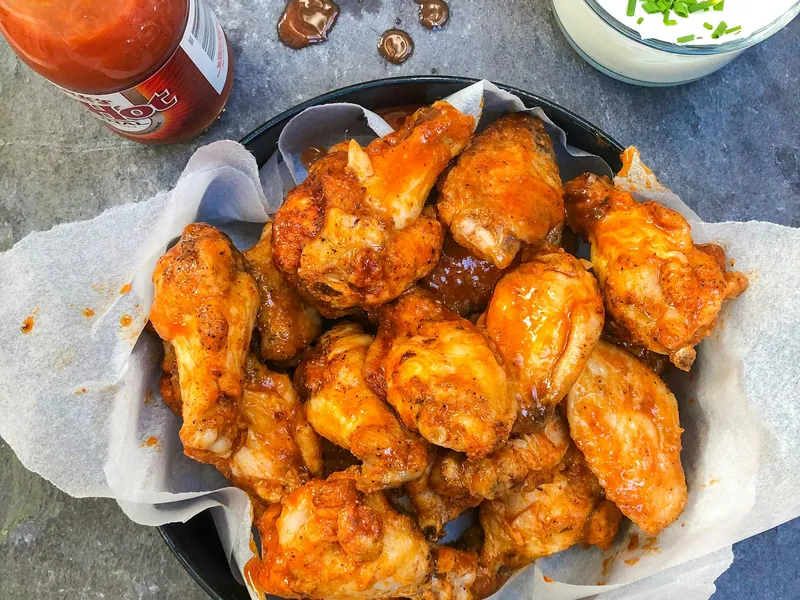
Crew Pack — Bone-In
Thirty classic wings, three flavours, three dips, large fries and veggie sticks at $34.79. Three hundred calories lighter than the boneless pack at 3,046 for the wings and 4,970 for the whole thing. The veggie sticks included here are not a token — celery between hot wings resets your palate in a way a cold drink cannot, and with three flavours running you will want that.
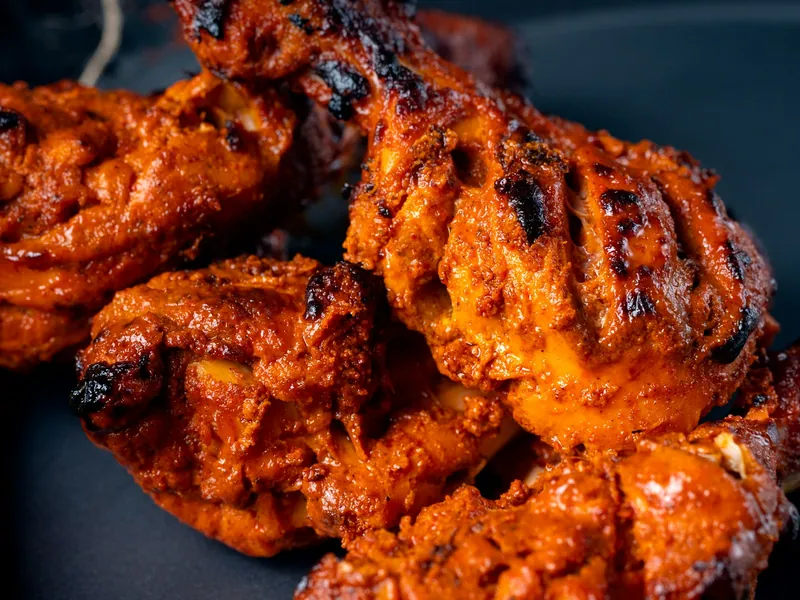
Group Pack — Boneless
Forty boneless wings across three flavours with four dips, two large seasoned fries and two veggie sticks. $40.29 covers five to six people comfortably. Note that the flavour allowance stays at three while the wing count rises to forty — if you want more variety than that, the Party Pack is the next step rather than this one. Wings 4,453 calories; complete pack 6,882.
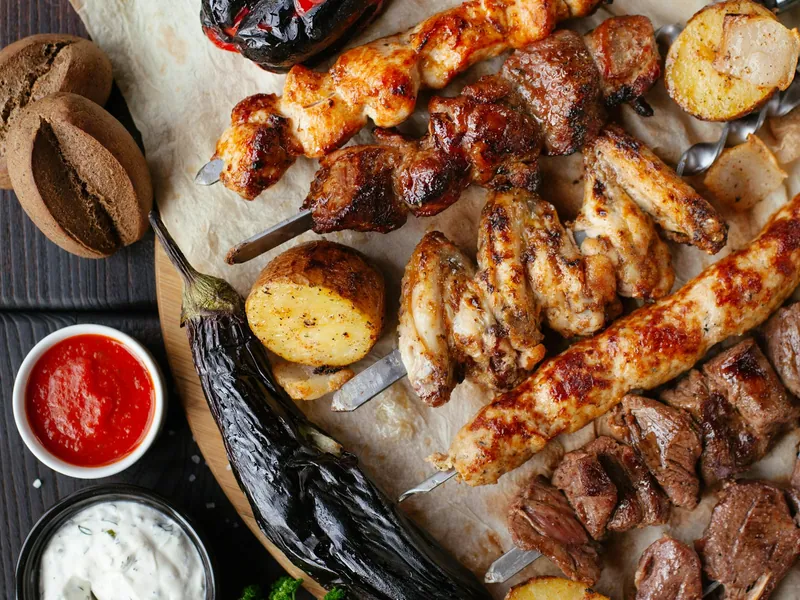
Group Pack — Bone-In
Forty classic wings, three flavours, four dips, two large fries and two veggie sticks at $44.29. The wings are 4,103 calories and the full pack 6,292. Two separate large fries rather than one enormous portion is the right call for a group — fries in a deep container steam themselves, and two shallower portions arrive in better condition than one deep one.
Party Pack — Boneless
Fifty boneless wings across four flavours with four dips, two large seasoned fries and four veggie sticks. At $49.99 this is the largest bundled pack and the best-value group order on the menu — around six to seven dollars a head for eight people, everything included. The four-flavour allowance is what separates it from the Group Pack. Wings 5,286 calories; the complete pack 8,527.
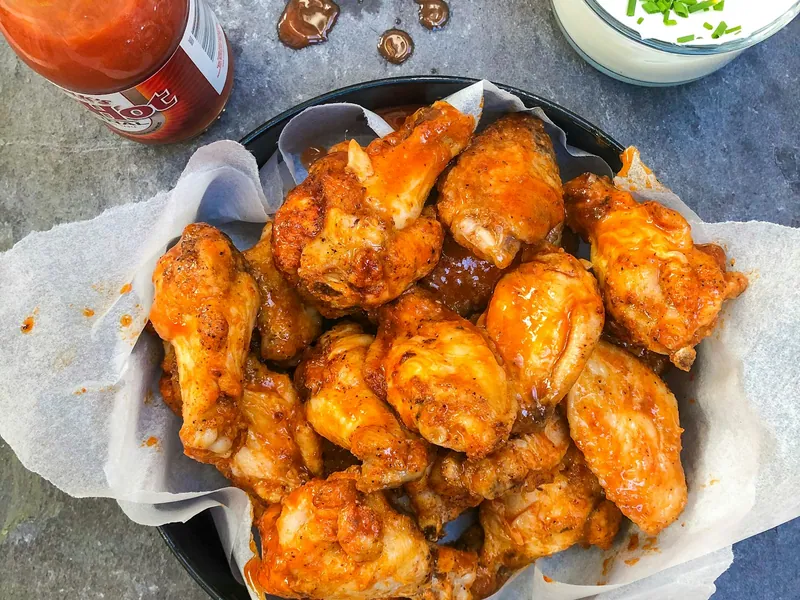
Party Pack — Bone-In
Fifty classic wings, four flavours, four dips, two large fries and four veggie sticks at $54.99. Four hundred calories under the boneless version at 4,873 for the wings and 8,127 for everything. This is the order for a gathering: four flavours covers the full heat range, four dips is enough that nobody runs out, and the veggie sticks are there for the people working through the Atomic.
Crispy Tenders
7 items
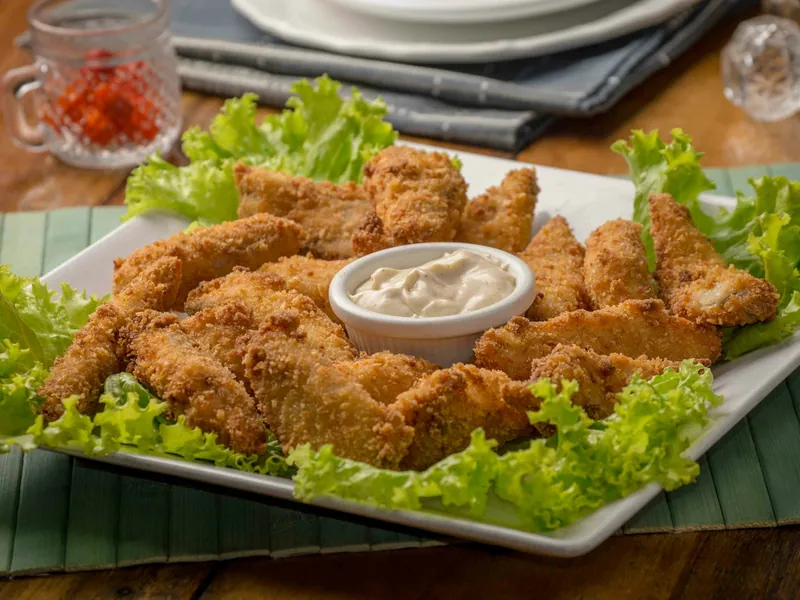
3pc Tenders Combo
Three crispy tenders with one dip, a regular seasoned fries or veggie sticks and a 20oz soft drink. At 410 calories for the tenders and 1,375 for the full combo, this is the lightest complete meal on the menu by a clear margin. Tenders take the dry rubs particularly well because the breading holds seasoning without going soggy, and they are the easiest thing here to eat one-handed.
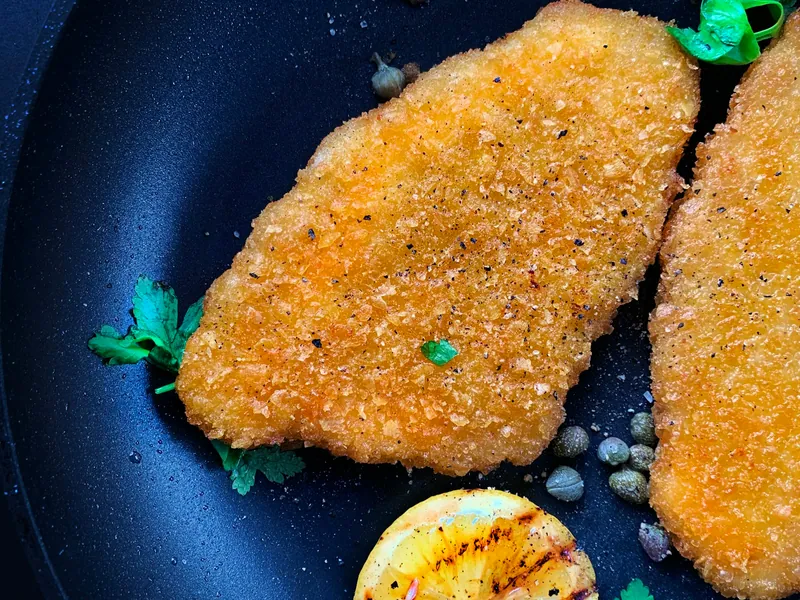
5pc Tenders Combo
Five crispy tenders, one dip, fries or veggie sticks and a 20oz drink at $11.29. The tenders are 675 calories and the complete combo 1,585. Two more tenders than the 3pc for $2.60, which is the same per-piece rate — unusually, this combo range does not reward stepping up. Order whichever count matches your appetite rather than looking for value in the jump.
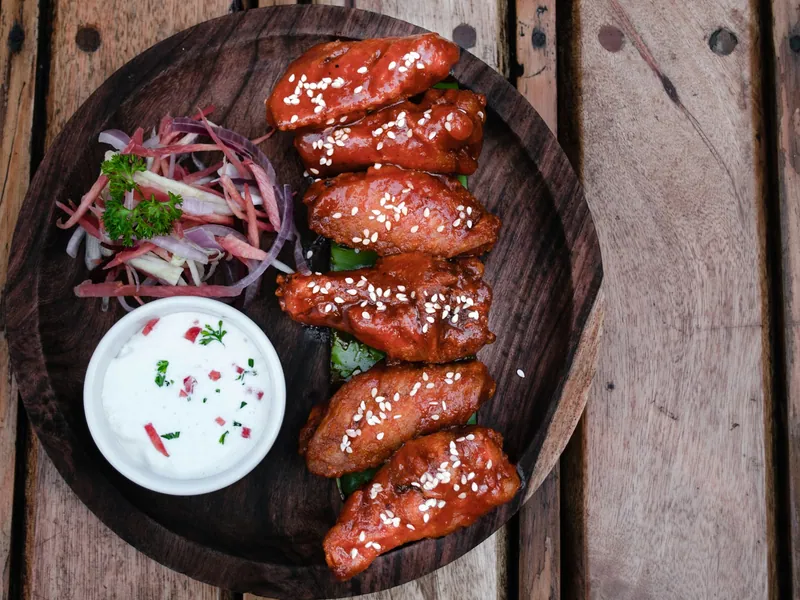
4pc Tenders
Four crispy tenders with one dip, no sides or drink. At $6.29 this is the cheapest item on the menu that constitutes a meal, and at 800 calories it is a substantial one. Tenders are whole tenderloin strips rather than portioned breast pieces, which gives them more pull and texture than boneless wings have.
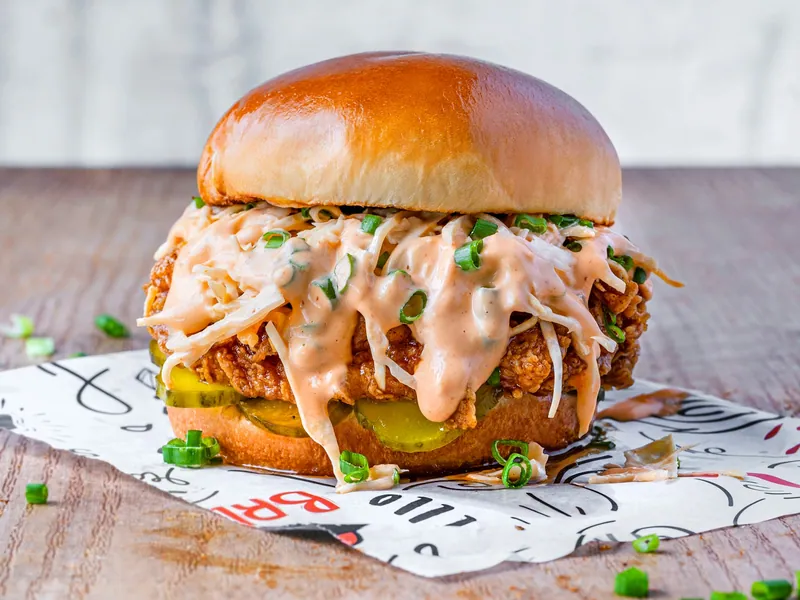
7pc Tenders
Seven crispy tenders with two dips at $9.99. The step from four to seven improves the per-piece rate meaningfully, and the second dip matters more than it sounds — one dip across seven tenders runs out around piece five. At 1,400 calories this feeds one hungry person or two moderate ones.
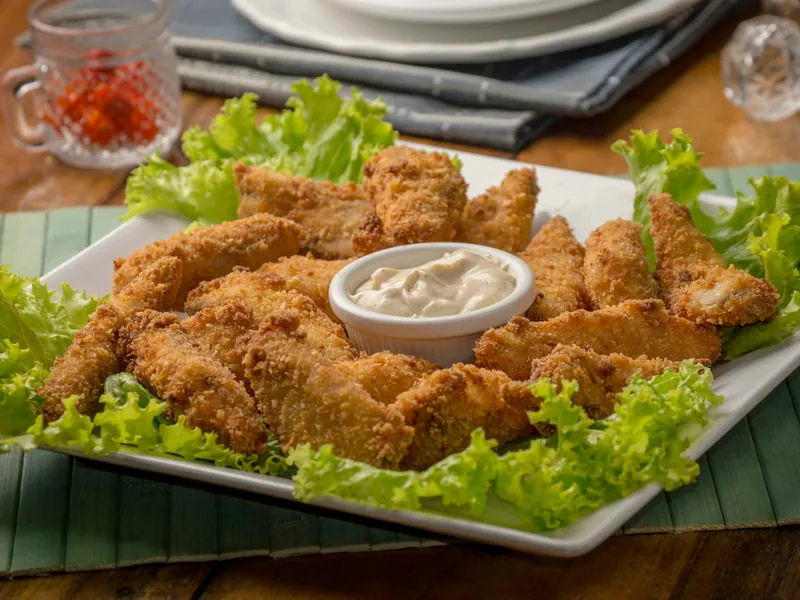
15pc Tenders
Fifteen crispy tenders with three dips at $21.39, 2,730 calories. This is the count where tenders become a genuine group order, and it is the format to choose for a table that includes children — tenders are familiar, easy to portion and require no negotiation about bones. Three dips across fifteen pieces is the correct ratio.
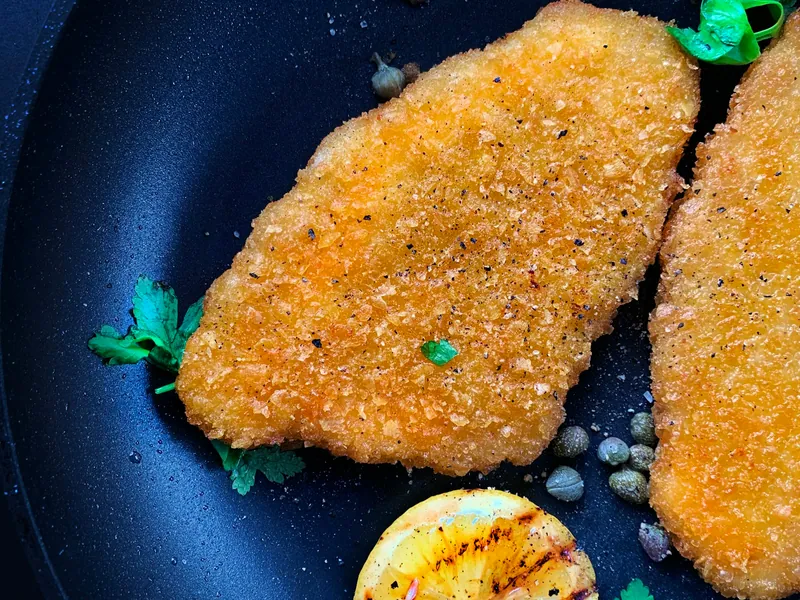
20pc Tenders
Twenty crispy tenders with four dips at $28.29, 3,640 calories. Feeds five to six. Worth comparing directly against twenty bone-in wings at $18.29 — the tenders cost ten dollars more but contain considerably more actual chicken, since there is no bone in the equation. On meat per dollar, tenders beat wings at every equivalent count.
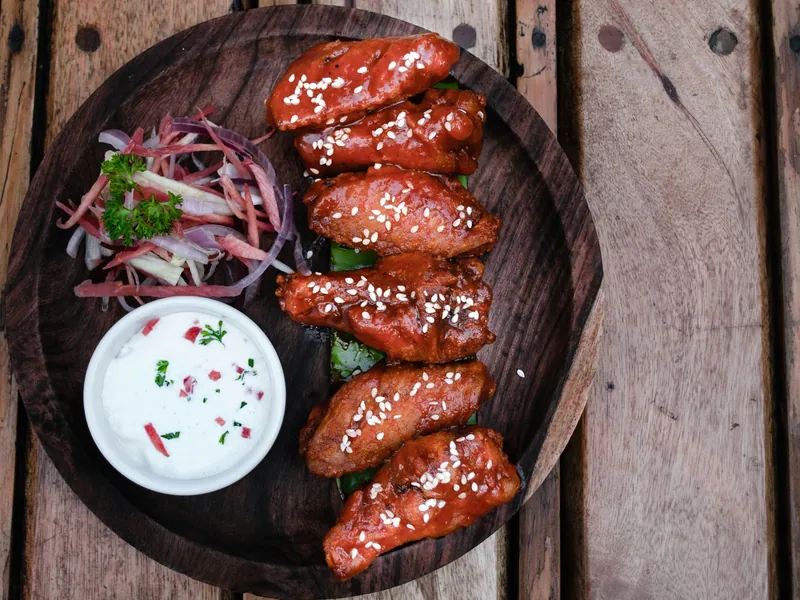
30pc Tenders
Thirty crispy tenders with four dips at $40.79, 4,740 calories. The largest tender order and a straightforward party format. Note the dip allocation stops rising at four here while the piece count reaches thirty — order extra dips at the counter, because ten tenders per dip is not enough and the fix costs $1.49 each.
Sides
2 items
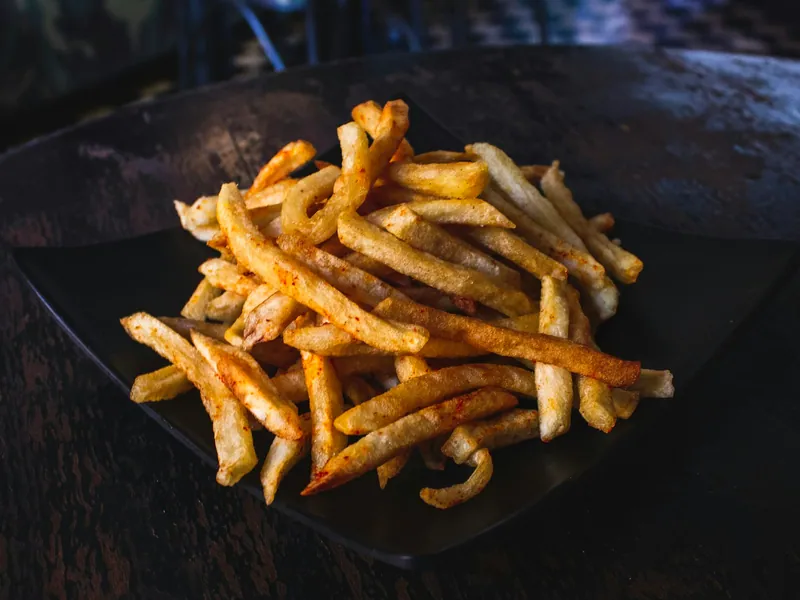
Seasoned Fries
Thick-cut fries carrying the same seasoning family as the dry rubs — salt, pepper and a savoury blend that makes them recognisably part of this menu rather than a generic side. A regular is 500 calories at $2.79; the large is 900 calories at $4.29. They are among the better fast-food fries available and they are also the item most damaged by travel: a closed container steams them within about ten minutes. If you are collecting, leave the bag open in the car.
Veggie Sticks
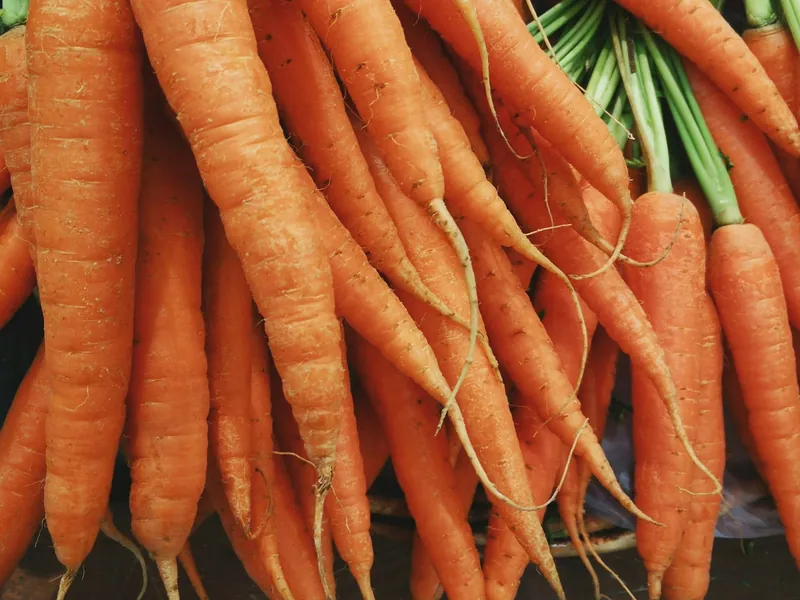
Celery and carrot sticks. At 40 calories for a regular and 70 for a large, this is the only genuinely light thing on the menu, and it is not a token gesture — celery is the correct palate cleanser between hot wings and works considerably better than a cold drink does. If you are ordering anything at the top of the heat scale, order these alongside it. Regular $1.59, large $3.09.
Extras & Loaded Fries
5 items
Louisiana Voodoo Loaded Fries
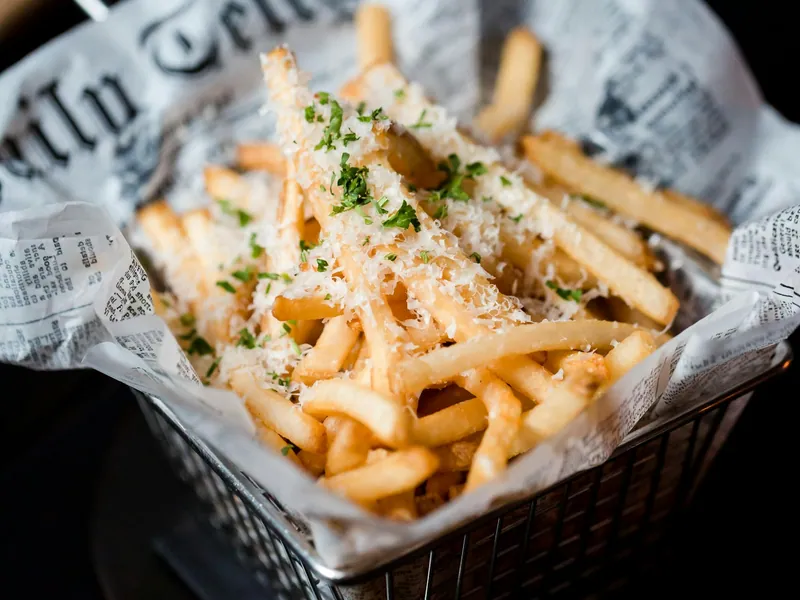
Seasoned fries loaded with cheese sauce and the Louisiana Rub seasoning. At 680 calories for a regular and 1,180 for a large, this is a meal-sized side rather than an accompaniment — ordering it alongside a 10pc combo produces considerably more food than most people intend. The Louisiana seasoning carries real heat, more than the name suggests, and it works better against the cheese than a milder rub would. Regular $5.19, large $6.29.
Buffalo Ranch Loaded Fries
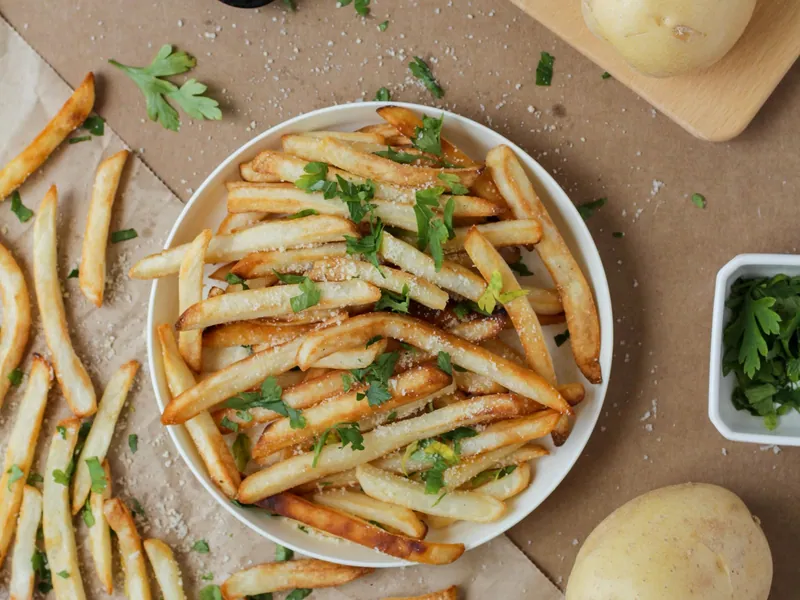
Seasoned fries with cheese sauce, buffalo sauce and ranch. Slightly lighter than the Voodoo version at 610 calories regular and 1,070 large, and considerably milder — the ranch cuts the buffalo heat rather than amplifying it. This is the loaded fries order for a table that includes someone who does not want spice. Regular $5.19, large $6.29.
Cheese Fries
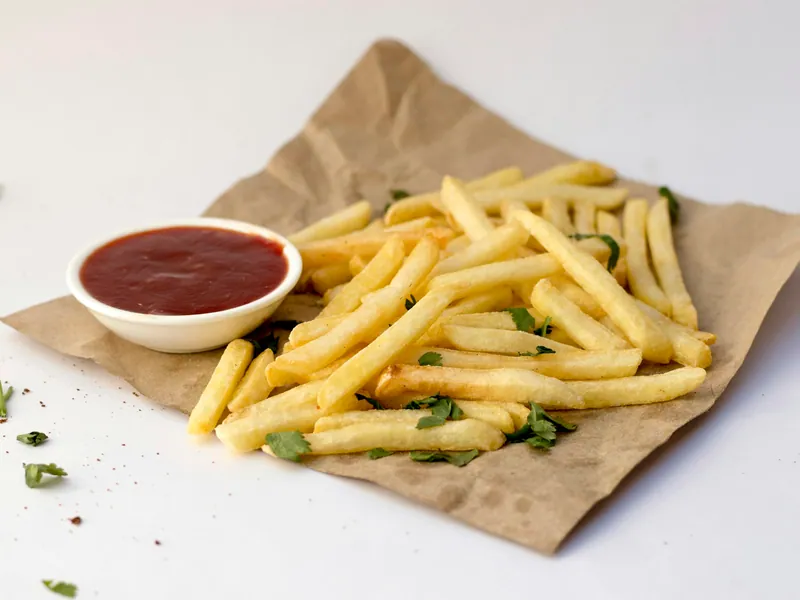
Seasoned fries with cheese sauce and nothing else. The simplest of the three loaded options, the cheapest at $4.59 regular, and the lightest at 580 calories regular and 1,020 large. It is also the one that works best alongside a strongly flavoured wing order, because it adds richness without adding a competing flavour. Regular $4.59, large $5.69.
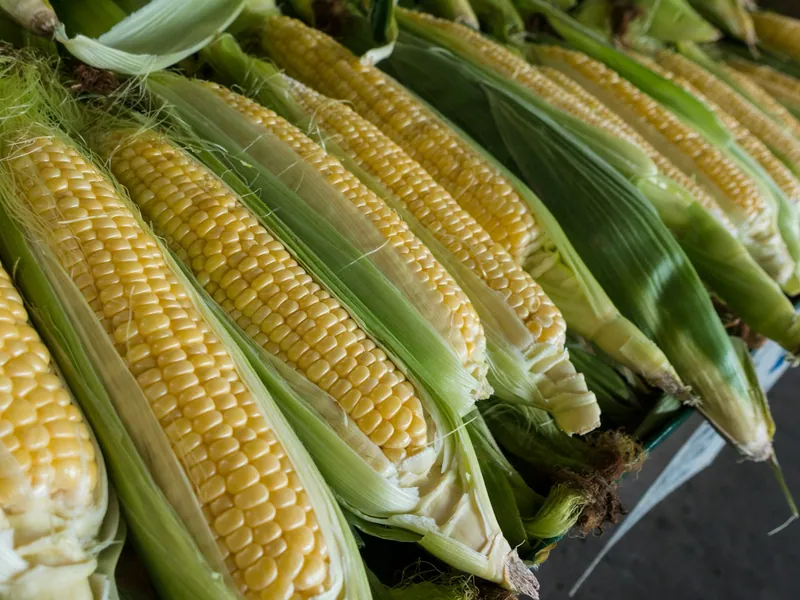
Cajun Fried Corn
Corn on the cob, fried and seasoned with the Cajun rub. At 200 calories for a regular and 400 for a large it is the lightest hot side on the menu, and it does something no other side does — the sweetness of the corn cuts through a large order of fried chicken in a way that more fried potato cannot. Messy, underordered and genuinely worth trying. Regular $3.59, large $4.99.
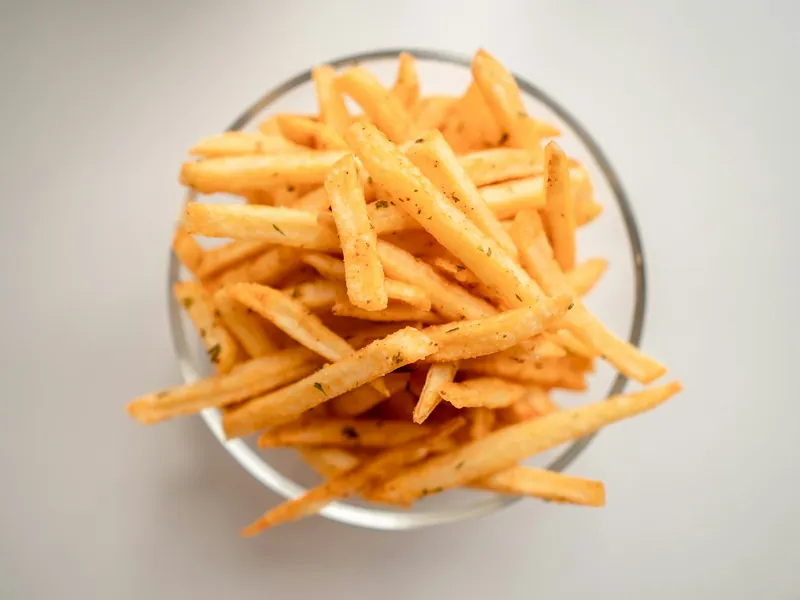
Cheese Sauce
A container of cheese sauce on its own at $3.99, 620 calories. Ordered as a dip for fries or wings by people who want the loaded-fries experience without committing the whole portion to it. At 620 calories it is the heaviest single add-on available and it is worth knowing that before it goes on top of an order that was already substantial.
Dips
3 items
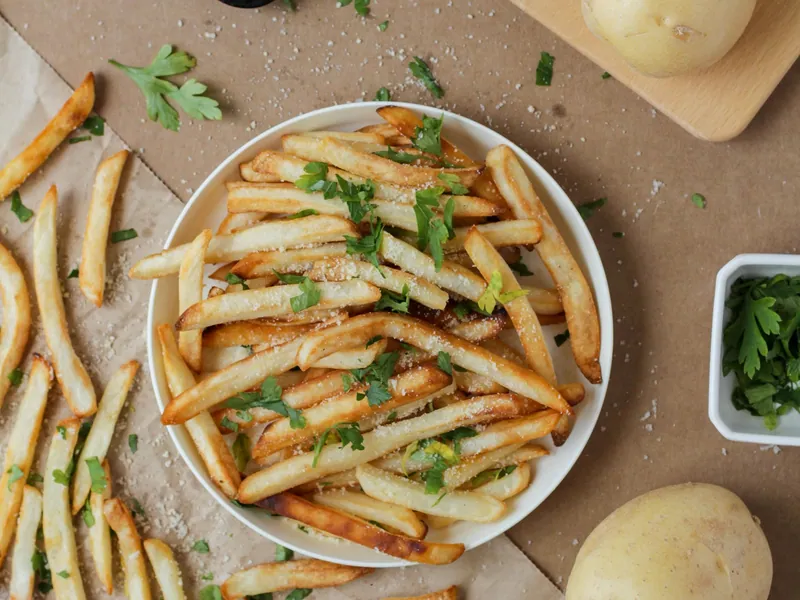
Ranch
Buttermilk ranch, and the default for good reason. It is creamy, herby and mild enough to work with everything on the board without competing, and the dairy in it genuinely binds capsaicin — which is why it is the functional part of an Atomic or Mango Habanero order rather than a preference. A regular is 320 calories at $1.49; the large is 1,620 calories at $4.49, which is worth pausing over before ordering one per person.
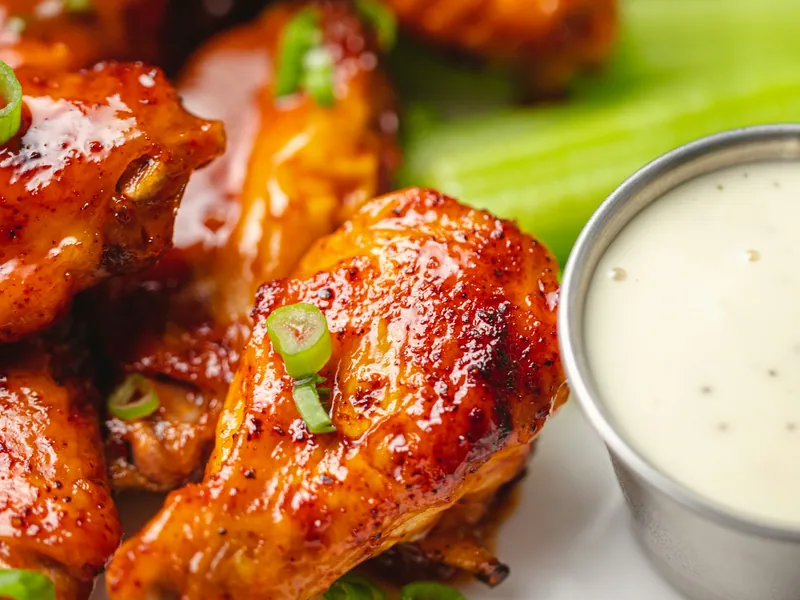
Bleu Cheese
Assertive, funky and the classic pairing for a vinegar-forward buffalo sauce. Excellent with Original Hot, where the two work against each other properly. A poor choice with Lemon Pepper or Hawaiian, where it simply overwrites what you ordered. Regular 330 calories at $1.49; large 1,630 calories at $4.49.
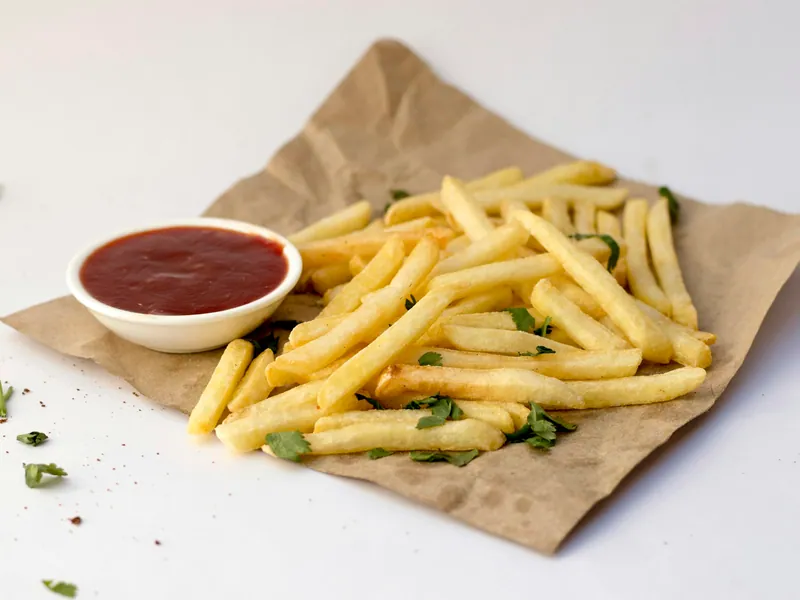
Honey Mustard
The underrated third option and the heaviest of the three at 390 calories regular, 1,950 large. It works particularly well with the crispy tenders and with the sweeter sauces, and it is the right dip for a child who finds ranch bland and bleu cheese alarming. Regular $1.49, large $4.49.
Drinks
4 items
Soft Drink
Coca-Cola and Dr Pepper products. A 20oz is $2.89 and a 32oz is $3.39, ranging from 0 to 500 calories depending on whether you take a regular or a diet option. Worth knowing that a fizzy drink does very little against capsaicin — it moves the heat around your mouth rather than removing it. If you are eating anything above the middle of the heat scale, the dip is doing that job, not the drink.
Dasani Bottled Water
Bottled water at $2.89, zero calories. The same price as a 20oz soft drink, which makes it the straightforward choice if you are watching the total of an order that is already substantial. It is also the only drink here that does not add sugar to a meal that has plenty of everything else.
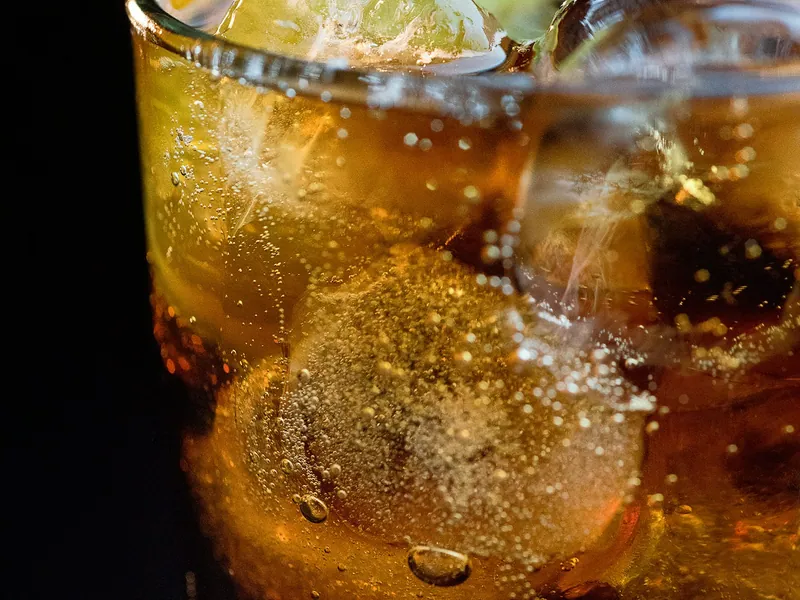
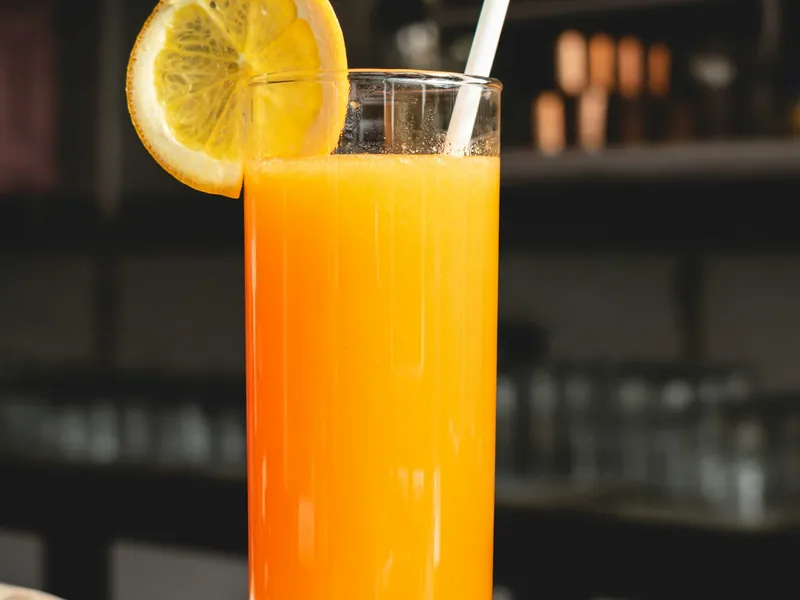
Simply Lemonade
A 52oz Simply Lemonade at $4.99, 840 calories. This is a shareable size rather than an individual drink, and the calorie figure is worth reading twice — at 840 it carries more than a 6pc order of boneless wings. Good with the hotter flavours, where the acidity works, but it is a substantial part of a meal rather than an accompaniment to one.
Gold Peak Tea
Iced tea in 20oz at $2.89 and 32oz at $3.39, ranging 0 to 390 calories depending on whether you take it sweetened. Unsweetened it is the only zero-calorie option besides water, and it stands up to the strongly seasoned food here better than water does.
Dessert
1 items
Current offers
Promo Codes Running Right Now
Checked August 12, 2026. These are platform offers — confirm the code is live before you build the order around it.
Exclusive $10 off orders through DoorDash
USGROUPON3Q26The largest single discount currently running. Applied at DoorDash checkout rather than in store or through the Wingstop app.
August Flavor Pick — save on the featured flavor
No code needed. A rotating monthly promotion on a featured flavor, applied automatically.
10% off pick-up orders through DoorDash
PICKUP10Pick-up rather than delivery, which is the version worth having — you avoid the delivery fee, the service fee and the tip entirely, and the food is in far better condition than it would be after twenty minutes in a car. A percentage discount also scales with the order, so this is the better code on a group pack where the $10 flat offers stop being proportionally useful..
Start here
What This Wingstop Menu Guide Actually Covers
This is an independent price and nutrition guide. It is not an ordering site, it is not run by the company, and it does not take payment. Every item is listed with a current estimated price, a calorie figure and a description written to tell you what the thing is actually like — not what a marketing department would say about it.
A guide like this exists because the information is oddly scattered. Locations are franchised and set their own prices, the board in your local shop does not carry calorie counts beside each item, and the flavour list tells you the names without telling you which ones will hurt. If you want to know what a 10-piece combo costs and what Atomic actually does to you before you are standing at the counter, that is surprisingly hard to find in one place.
So the Wingstop menu is laid out here by section, with prices and calories side by side, plus the things that genuinely change the decision: how bone-in and boneless differ on both counts, which flavours are hot and which only sound hot, how many wings a given number of people actually needs, and where the bundles stop being good value.
Prices are typical U.S. estimates gathered from public sources and reviewed monthly. They will not match your local store to the cent, and the section on location pricing further down explains why. Calorie figures are for standard preparations; the section on nutrition explains what changes them.
Prices
Wingstop Menu Prices by Section
Wing pricing is built around count rather than weight, which is unusual and worth understanding first. You are buying 6, 8, 10, 15, 20, 30, 50, 75 or 100 pieces, and the price per wing falls as the count rises. That single fact drives almost every value decision on the board.
A 6-piece combo — wings, seasoned fries, a dip and a drink — typically lands somewhere between $10.79 and $11.99 depending on location and on whether you choose classic or boneless. A 10-piece combo runs higher, and the large group packs at 50, 75 and 100 pieces climb steeply in absolute terms while continuing to fall per wing.
Tenders are priced on a parallel scale and generally land in a similar range to boneless for an equivalent amount of chicken. A tender meal typically runs somewhere between $9 and $23 depending on piece count and what comes with it.
Sides sit at the bottom of the price list and are where a bill quietly grows. Seasoned fries, Cajun fried corn and veggie sticks are individually inexpensive; ordered for four people alongside a group pack they add a meaningful amount to a total that was calculated on wings alone.
Dips are the smallest line on the menu and the one most likely to be underestimated. Ranch and bleu cheese are charged individually beyond what a combo includes, and a table of four working through wings will want more than the combo allocation. Two extra dips is not a large sum; six is noticeable.
Every price on this page is for a standard order unless stated otherwise. Boneless and classic frequently differ, and that difference is not consistent between locations.
The flavours
Every Wingstop Flavor, Explained Honestly
This is the part of the Wingstop menu people actually search for, and most guides just list the names. Names tell you nothing. What follows is what each flavour is like to eat, which ones are dry rubs and which are wet sauces, and which are worth your one order if you are only having one.
The first thing to understand is the split. Some flavours are wet sauces, tossed on and dripping; others are dry rubs, seasoned onto the wing with no sauce at all. That distinction matters more than the flavour names do, because it changes the texture completely, it changes how well the wings travel, and it changes what happens when you add a dip.
Roughly half the flavours on the Wingstop menu are dry rubs, and dry rubs stay crisp. They travel better, they hold up for the twenty minutes between the shop and your table, and they leave the skin intact. Wet sauces soften the coating from the moment they are applied and are at their best eaten immediately. If your order is going in a car, that alone should steer at least half of it.
The board carries twelve permanent flavours, with limited-time additions rotating through on top of that. The permanent list is the one worth knowing, because a limited flavour you fall in love with may not be there next month.
Lemon Pepper (dry rub)
The best-seller and the one to order first. A citrus-forward dry rub with real pepper behind it, barely any heat, and it keeps the skin crisp. It is also the flavour that survives a journey home best, which is why it is the default for delivery orders. If you order one thing, order this.
Garlic Parmesan (dry rub)
The other best-seller and the savoury counterpart to Lemon Pepper. Buttery, cheesy, no heat at all. It is rich in a way that makes ten of them feel like more than ten, so it works better as half an order than as a full one. Excellent with celery, which cuts through it.
Original Hot (wet sauce)
The classic buffalo profile — vinegar-forward, moderate heat, the flavour most people picture when they think of a chicken wing. It is the reference point the rest of the wet sauces are measured against, and it is the safest order for someone who wants heat but does not want an event.
Mild (wet sauce)
Original Hot with the heat pulled back. Genuinely mild rather than nominally mild, which makes it the right order for children and for anyone who wants buffalo flavour without any burn. It carries slightly more butter character than the hot version.
Cajun (wet sauce)
A wet sauce with dry-rub seasoning worked into it, which gives it more depth than a straight buffalo. Meaningfully hotter than Original Hot and more complex — there is a savoury, herby base underneath the heat. This is the connoisseur pick among the mid-heat flavours.
Louisiana Rub (dry rub)
The dry rub for people who want heat. It carries a Cajun spice profile without the sauce, so you get the crispness of a rub with a real kick. Underordered relative to how good it is, largely because it sits between the famous rubs and the famous sauces on the board.
Atomic (wet sauce)
The hottest thing on the menu and not a joke order. Serious capsaicin heat that arrives fast and stays for several minutes. A full order of Atomic is a challenge rather than a meal for most people, and the sensible move is to make it part of a mixed order rather than all of it. Ranch is not optional here.
Mango Habanero (wet sauce)
One notch below Atomic and, for a lot of people, the better order. Real habanero heat with mango sweetness in front of it, so the first second is fruit and the rest is fire. The sweetness makes it more moreish than Atomic, which is exactly how people end up further through an order than they intended.
Spicy Korean Q (wet sauce)
Sweet, sticky, garlicky and moderately hot. Closer to a Korean fried chicken glaze than to buffalo, and it is the flavour that most divides opinion — people who want a traditional wing find it too sweet, and people who like it order nothing else. Very much worth trying once.
Hickory Smoked BBQ (wet sauce)
Sweet, smoky, no heat. The safe order for a table that includes people who do not like spice, and the one children reliably choose. It is a competent barbecue sauce rather than a remarkable one, and it is the wettest of the sauces, so it suffers most from a long journey.
Hawaiian (wet sauce)
Sweet and tangy with a tropical citrus profile and no meaningful heat. It is the mildest of the sweet sauces and it is genuinely popular with people who do not otherwise like wings. Order it as a contrast within a mixed order rather than on its own.
Hot Honey Rub (dry rub)
The heaviest flavour on the board at 260 calories, and a dry rub rather than a sauce — so you get sweetness and heat while the skin stays crisp. That combination is unusual and it is the reason this one is worth knowing about. Honey sweetness sits in front of a genuine chilli warmth, and because it is a rub it survives a journey home far better than any of the sweet wet sauces do. The right order for someone who wants Spicy Korean Q flavours in a format that travels.
Heat
Wingstop Flavors Ranked by Heat — What You Are Actually Signing Up For
Flavour names on the Wingstop menu are a poor guide to heat. "Mango Habanero" sounds like a fruit sauce and is one of the hottest things on the board; "Cajun" sounds fierce and sits in the middle. Here is the working order, hottest to mildest, along with what each level actually feels like.
Atomic is the top of the scale and should be treated as such. The heat arrives within a couple of seconds, builds rather than fading, and stays present for several minutes after you stop eating. It is genuinely hot rather than restaurant-hot. A full order is a lot of commitment.
Mango Habanero sits just below it and is the one that catches people out. The mango hits first and the habanero follows, so the first bite reads as manageable and the fourth does not. The sweetness makes it easy to keep eating, which is precisely the problem.
Cajun and Original Hot occupy the middle. Cajun runs a little hotter and considerably more complex; Original Hot is the straightforward vinegar-and-butter buffalo profile. Either is a comfortable order for someone who eats spicy food normally and neither will ruin an evening.
Spicy Korean Q and Louisiana Rub sit just below that. Both carry real heat but it is secondary to the flavour rather than the point of it. Louisiana Rub in particular delivers more heat than most people expect from a dry rub.
Mild and Lemon Pepper are at the low end with a trace of warmth. Garlic Parmesan, Hickory Smoked BBQ, Hawaiian and Plain have no meaningful heat at all.
The practical advice for a table: order across the range rather than picking one. A mixed order of a rub, a mid-heat sauce and one hot flavour gives everyone something and lets people calibrate. Ordering twenty wings of a single hot flavour is how a group ends up with fifteen wings nobody wants.
And take the ranch with anything above the middle of the scale. Dairy genuinely works against capsaicin in a way that a cold drink does not — a fizzy drink spreads the heat around your mouth rather than removing it.
The main decision
Bone-In vs Boneless — the Difference Nobody Explains Properly
This is the first question the Wingstop menu asks you and the one most people answer out of habit. The two are genuinely different products, not two formats of the same thing, and the differences run in directions that surprise people.
Classic wings are actual chicken wings — bone in, skin on, fried. Boneless wings are not wings at all. They are pieces of breast meat, breaded and fried, shaped into wing-sized portions. Calling them wings is a naming convention rather than a description.
That has a direct nutritional consequence and it goes the opposite way from what most people assume. A boneless wing typically carries meaningfully more calories than a bone-in one — somewhere in the region of 130 to 180 against 80 to 120 — because the breading absorbs oil in a way that skin does not, and because you are eating more actual food per piece with no bone taking up space.
Boneless also carry more carbohydrate, for the same reason: they are breaded. Anyone ordering boneless because it sounds like the lighter or leaner option has it backwards, and it is one of the most common misreadings of any fast-food menu in the country.
On eating experience, classic wings win on flavour and lose on convenience. Skin holds sauce and dry rub far better than breading does, the meat stays moist against the bone, and the whole thing tastes more like chicken. Boneless are easier to eat, better in a car, and better for children, and the breading gives a satisfying crunch that skin does not.
On value, count matters. Ten boneless is more food than ten classic, because there is no bone in the way. If you are comparing two orders at the same piece count, boneless gives you more chicken — which is either good value or an unintended larger meal depending on how you were thinking about it.
The honest recommendation: order classic if you care about the wings, boneless if you care about convenience, and a mixed order if you are feeding a group with no strong opinion. And if you are ordering boneless for health reasons, order fewer of them rather than switching, because the switch itself achieves the opposite of what you wanted.
Tenders
Crispy Tenders — Who They Are Actually For
Chicken tenders sit on the Wingstop menu alongside wings and get ordered far less than they should. They are whole tenderloin strips, breaded and fried, and they are tossed in exactly the same flavour range as the wings.
The confusion is with boneless. People assume tenders and boneless wings are the same product in different shapes, and they are close but not identical — tenders are a larger, single piece of a specific cut, while boneless are portioned pieces of breast. In practice the difference you notice is texture: a tender has more pull to it, and boneless are more uniform.
Tenders are the right order in three specific situations. For a child, because they are familiar, easy to eat and easy to portion. For someone who wants the flavours without the mess, because a tender can be eaten with two fingers and no sauce down your wrist. And for anyone who finds wings poor value on a meat-per-dollar basis, because there is no bone in the equation at all.
They are the wrong order if what you actually wanted was wings. A dry rub on a tender is not the same experience as a dry rub on crisp chicken skin, and no amount of enthusiasm for the format closes that gap. The skin is doing real work on a classic wing.
On flavour selection, tenders take dry rubs particularly well because the breading holds seasoning without going soggy. Wet sauces on tenders are perfectly good but soften the coating quickly, so take the sauce on the side if the order is travelling.
For a mixed group order, tenders are the underrated inclusion. A box of tenders alongside wings gives the people who did not want to negotiate with a bone something substantial to eat, and it costs less drama than everybody trying to agree on one flavour.
How much to order
How Many Wings Do You Actually Need?
This is the question that decides whether an order is right, and it is the one most groups get wrong in both directions. The counts on the Wingstop menu run 6, 8, 10, 15, 20, 30, 50, 75 and 100, and the price per wing falls as the count rises.
For one person as a full meal with fries, six to eight classic wings is enough for most adults. Ten is a substantial meal. Anyone ordering fifteen for themselves is either very hungry or planning to have leftovers, and wings are among the worse foods to reheat.
For boneless, subtract roughly two from those numbers. A boneless piece is more food than a classic wing at the same count, so eight boneless is closer to ten classic in practice.
For a group, the working figure is six to eight wings a head if there are sides, and ten if there are not. A group pack of 30 covers four people comfortably with fries; 50 covers six to eight; the 75 and 100 counts are party orders rather than dinner orders and should be treated as such.
The count where value changes most sharply is the jump from the small combos into the 20 and 30 packs. Below that you are paying a per-wing premium for the convenience of a combo; above it the per-wing rate drops meaningfully. Two people ordering one 20-piece with sides will almost always do better than two people ordering two 8-piece combos.
The trap in the other direction is ordering a large pack to get the better rate and then not eating it. Wings are excellent fresh and mediocre reheated — the skin softens, the sauce congeals, and a reheated wing is a fraction of what it was. A per-wing saving on food nobody eats is not a saving.
One practical note for mixed groups: most counts above ten can be split across multiple flavours. Ask. A 20-piece as two flavours of ten is the single best way to feed four people who cannot agree, and it costs nothing extra.
Combos
Combos and Meal Deals — Where the Value Is and Is Not
A combo on the Wingstop menu bundles wings with seasoned fries, a dip and a drink at a price below buying those four things separately. That is a genuine discount and the arithmetic is real.
The question worth asking is whether you wanted all four. A combo is only cheaper than the alternative if the alternative was buying the same items — and for a lot of people the honest alternative was wings and tap water. If you would not have bought the drink, the combo is charging you for a discounted drink you did not want rather than saving you money.
That said, for a single person eating in, the small combos are straightforwardly good value and the easiest way to order. The fries are genuinely good, the dip is necessary rather than optional with most flavours, and the whole thing is priced sensibly.
Where combos stop being the right call is at group size. Four people ordering four individual combos will pay considerably more than the same four sharing a 30-piece pack with two large fries, and will end up with four small portions of fries instead of enough for everyone. Above about three people, packs beat combos every time.
The other thing worth checking is what the combo dip allocation actually is. Most include one, and most people eating wings want more than one. Two extra dips across a table is not a significant cost, but it is a cost that appears after the combo maths was done, and it is the most common reason a bill comes in above the estimate.
On drinks specifically: this is where a group order inflates fastest. Four combo drinks cost more than a single large bottle for the table would, and nobody notices because each one was bundled into a price that looked reasonable on its own.
Group orders
Bundles and Group Packs — Feeding Four or More
Above about three people the Wingstop menu changes shape. The individual combos stop being the sensible unit and the bundles take over, and the difference in total cost is larger than most groups expect.
The structure of a bundle is consistent: a large count of wings, sometimes mixed across classic, boneless and tenders, with large fries and multiple dips. Priced per head it lands well below the equivalent number of individual combos, and it solves the problem of everybody wanting something slightly different.
The mixed bundles are the ones worth paying attention to for a group with divided opinions. A pack that includes classic wings, boneless and tenders together removes the negotiation entirely — the people who want bones get bones, the people who want breading get breading, and nobody has to compromise on a single format for the whole table.
The practical advice for splitting flavours: reduce variety rather than maximise it. Three flavours across a large order is enough to cover a group — one dry rub, one mid-heat sauce, one sweet or barbecue option. Five flavours across the same order produces small quantities of each, more chance of an error, and a box where nobody can tell what they are picking up.
On sides, order fewer and larger. Four regular fries cost more and arrive in worse condition than two large ones split across the table, because fries in small containers steam themselves and go soft faster.
And order dips deliberately rather than accepting the default allocation. A group working through thirty wings wants more dip than a bundle includes, and buying two extra at the point of ordering is cheaper and less annoying than realising halfway through.
For anything above about fifty pieces, ring ahead or order well in advance. Everything here is cooked to order, and a large order arriving unannounced at a busy Friday evening will wait, which is nobody's fault but is entirely avoidable.
Deals
The Deals Worth Knowing About
The most useful recurring promotion on the Wingstop menu is reduced-price boneless wings on specific weekdays. Where it runs, it is a substantial discount on the per-wing rate and it is the cheapest route to a large quantity of chicken on the entire menu.
Two caveats keep it honest. Which days it runs on varies, and it has changed over time, so it is worth confirming rather than assuming. And it applies to boneless rather than classic, so if you specifically want bone-in wings the promotion is not for you.
Used well, it is genuinely the best value available. A group ordering boneless on a promotional day, with one large fries and extra dips, will eat for meaningfully less per head than the same group on any other day. If your week is flexible at all, moving a takeaway to that day is the single largest saving on this page.
Beyond the recurring promotion, the app is where the rest of the value sits. Offers are frequently app-exclusive and are not posted in store, which means the only way to know what is running is to open it before ordering rather than after. That is a behavioural change rather than a financial one, and it is the whole argument for having the app.
Ordering ahead through the app also solves the real problem with this food, which is timing. Everything is cooked to order, so there is a genuine wait — ordering ten minutes before you arrive means collecting hot wings rather than standing in a shop watching a fryer.
What is not a deal: third-party delivery. Menu prices on delivery platforms commonly run well above in-store prices before any fee is applied, and then the delivery fee, service fee and tip go on top of the inflated subtotal. Wings also travel worse than almost any other takeaway food. Occasional delivery is a reasonable thing to pay for; habitual delivery is quietly the largest line in most people's spending here.
Sides
Seasoned Fries, Cajun Corn and the Rest of the Sides
The sides are the shortest section of the Wingstop menu and the seasoned fries are not an afterthought and they are the reason a lot of people order here rather than somewhere else. They carry the same seasoning family as the dry rubs, they are cut thick enough to stay soft inside, and they are genuinely one of the better fast-food fries available.
They are also the item most damaged by travel. Fries in a closed container steam themselves within about ten minutes, and a fifteen-minute drive home turns excellent fries into acceptable ones. If you are collecting, ask for them to go in last and leave the bag open on the passenger seat rather than sealed.
Cajun fried corn is the side people walk past and should not. Corn on the cob, fried, seasoned with the Cajun rub. It is messy, it is very good, and it does something no other side on the menu does — it cuts through the richness of a large wing order in a way that more fried potato cannot.
Veggie sticks — celery and carrot — serve a genuine function rather than being a token healthy option. Celery in particular is the correct palate cleanser between hot wings, and it works considerably better than a cold drink. If you are ordering anything above the middle of the heat scale, order the sticks too.
On quantity: order large and share rather than regular each. Two large fries between four people is more food, better value and better condition than four regular portions, for the reason above about steaming.
Sides are also where the calorie total of an order climbs without anybody noticing. A large seasoned fries alongside a ten-piece combo is a substantial addition to a meal that already included fries in the combo, and doubling up on fries is the most common way an order becomes heavier than intended.
Dips
Ranch vs Bleu Cheese — and Why It Matters More Than You Think
The dip choice looks like the most trivial decision on the Wingstop menu and it is not, for two reasons: one about flavour and one about heat.
On flavour, ranch is the neutral option. It is creamy, herby and mild, and it works with everything on the menu without competing. Bleu cheese is assertive — it has its own strong flavour and it will dominate anything subtle. That makes it excellent with Original Hot, where the vinegar and the funk work against each other properly, and a poor choice with Lemon Pepper or Hawaiian, where it simply overwrites what you ordered.
On heat, both work, and they work because of dairy rather than because of temperature. Capsaicin is not water-soluble, which is why a cold drink moves the burn around your mouth rather than removing it. The fat and casein in a dairy-based dip genuinely bind it. That is why ranch alongside Atomic is not a preference — it is the functional part of the order.
The practical rule: ranch with dry rubs and with anything sweet, bleu cheese with the classic buffalo sauces, and always ranch with anything at the top of the heat scale regardless of which you normally prefer.
Order more than you think you need. The single most common small regret in a wing order is running out of dip with six wings left, and an extra dip costs very little against the price of the order it is rescuing.
Honey mustard, where available, is the underrated third option. It works particularly well with tenders and with the sweeter sauces, and it is the right dip for a child who finds ranch bland and bleu cheese alarming.
The sandwich
The Chicken Sandwich — Worth Ordering or a Distraction?
The chicken sandwich is the newest addition to the Wingstop menu, arriving relatively recently in the chain's history and it sits slightly awkwardly on a menu that is otherwise entirely about wings. It is a fried chicken breast on a bun, available in the same flavour range as everything else, and the flavour range is the whole argument for it.
Most chicken sandwiches offer you plain, spicy, or plain with a sauce packet. Here you can have one in Lemon Pepper, in Garlic Parmesan, in Mango Habanero or in Atomic, which is a genuinely different proposition and the reason to order it over the equivalent at a chain built around sandwiches.
Where it falls down against those chains is the bun and the build. A restaurant that has spent years optimising one sandwich will beat a restaurant that added one to a wing menu, and it is worth going in with that expectation rather than being disappointed by it.
The situation where it makes clear sense: you want the flavours, you are eating in a car or at a desk, and wings are impractical. A sandwich is a one-handed food and a wing emphatically is not. For a lunch break that is a real advantage.
It also works as the order for someone in a group who does not want to negotiate over a shared box. A sandwich is self-contained, arrives as one thing, and does not require agreeing on a flavour with three other people.
On flavour selection, the dry rubs work better on a sandwich than the wet sauces do, for the same reason they work better on everything: a wet sauce and a bun together produce a structural problem within about four minutes. If you want a sauced version, take the sauce on the side and add it as you go.
Nutrition
Wingstop Calories — Where the Numbers Actually Come From
Nothing on the Wingstop menu is a light meal and no guide should pretend otherwise. What is useful is knowing which parts of an order carry the weight, because they are not the parts most people assume.
Start with the wing itself. A classic bone-in wing typically lands somewhere in the region of 80 to 120 calories. A boneless wing runs meaningfully higher, roughly 130 to 180, because of the breading and because there is no bone displacing meat. Ten boneless is therefore substantially more than ten classic before any sauce is involved.
The flavour contributes far less than people expect. Dry rubs add only a handful of calories per wing — they are seasoning rather than a coating. Wet sauces add somewhat more, in the region of ten to twenty calories per serving, with the creamier and sweeter sauces at the higher end. Either way, the flavour choice is close to a rounding error against the wing count.
That is the single most useful fact in this section. If you are managing the total, the lever is how many wings and which type, not which flavour. Switching from Atomic to Lemon Pepper to save calories achieves almost nothing; switching from twelve boneless to eight classic achieves a great deal.
The sides and the dips are where the rest of it lives. Seasoned fries are a substantial addition, and a dip is not trivial — ranch and bleu cheese are both fat-based and a full container adds meaningfully. A ten-piece combo with fries and a drink typically lands somewhere between 1,400 and 2,100 calories depending on wing type, and the wings themselves are frequently under half of that.
Sodium deserves a mention because it is the figure nobody checks and the one that runs highest here. Dry rubs are salt-based by construction, the sauces carry salt, and the seasoned fries carry it too. If sodium is a medical concern rather than a general preference, plain wings with sauce on the side is the only order that gives you real control.
For exact figures on a specific order, the company publishes full nutrition data and that is the authoritative source. This page is about which direction to move, not about precise numbers on a custom build.
Lighter orders
The Lightest Ways to Eat Here, Honestly
There is no genuinely light meal on the Wingstop menu and any guide claiming otherwise is selling something. What there is, is a wide range between the lightest reasonable order and the heaviest, and the gap is worth several hundred calories.
The lightest sensible order is a small count of classic bone-in wings in a dry rub, with veggie sticks instead of fries, and water. Bone-in over boneless is the biggest single decision, the dry rub avoids the sauce, and swapping the fries removes the largest side contribution.
The second lever is sauce on the side. Ordering wet-sauced wings with the sauce separate lets you apply a fraction of what the kitchen would toss them in, and on the sweeter sauces that is a real difference. It also keeps the skin crisp, so it improves the wings as well as the numbers.
The third is the dip. One dip shared rather than one each across a table is a straightforward reduction that nobody notices, and celery does the palate-cleansing job that people often use dip for.
What does not help: switching to boneless. This is the change people make most often when trying to eat more lightly here, and it moves the number in the wrong direction. Boneless are breaded, they absorb more oil, and they carry more calories and carbohydrate per piece.
Also unhelpful: switching flavours. As above, the flavour is close to irrelevant against the wing count. Ordering Lemon Pepper instead of Hickory Smoked BBQ is a taste decision, not a nutritional one.
The honest framing is that this is a treat meal and it works best treated as one. Ordering deliberately once is a better outcome than ordering apologetically every week, and nothing on this page is an argument for eating wings you do not want.
Ordering well
How to Order Well — the Things Regulars Do
Everything on the Wingstop menu is cooked to order, which is the single fact that explains most of the good advice about this menu. It is why there is a wait, why the food is better than it needs to be, and why several small requests that would be unreasonable elsewhere are routine here.
Split your flavours. Most counts above ten can be divided across two or more flavours at no extra cost. A 20-piece as two tens is the single best way to feed a group that cannot agree, and a great many people do not know it is available.
Ask for extra crispy. A longer fry produces a firmer skin and a wing that survives the journey home considerably better. It adds a few minutes and it is a completely normal request.
Take wet sauces on the side if the food is travelling. Sauce applied at the shop starts softening the coating immediately. Applied at your table twenty minutes later, you get the wing the kitchen actually made.
Order dry rubs for delivery and wet sauces for eating in. This one rule will improve more takeaway orders than everything else on this page combined. Lemon Pepper travels; Hickory Smoked BBQ does not.
Order more dip than the combo includes. Running out with six wings left is the most common small regret in a wing order, and the fix costs very little.
Use the app and order ahead. Cooked to order means a real wait at peak. Ten minutes of notice converts standing in a shop into collecting a bag.
Order the veggie sticks with anything hot. Celery between wings resets your palate in a way that a drink cannot, and it makes the last few wings of a hot order as enjoyable as the first.
One thing worth saying plainly: none of these requests is unusual and none of them will annoy anybody. Staff at a place that fries to order field them constantly, and the only reason more people do not ask is that they do not know they can.
Why prices differ
Why Your Local Prices Do Not Match This Page
Prices on the Wingstop menu are set locally: locations are independently franchised and set their own prices within whatever framework the parent company provides. That is the complete explanation for the variation you will see between two stores in the same city, and it is not an inconsistency — it is how the model works.
The practical result is a spread of roughly twenty to thirty percent between the cheapest and most expensive markets in the country for the same order. A combo that is around $10.79 in a suburban strip mall is comfortably above $12 in a dense urban market, and neither figure is wrong.
Three categories of location run consistently above the local norm. Dense city-centre stores, where rent and wages are both higher. Airport and transport-hub locations, where a captive audience adds a further premium. And university campus outlets, which are frequently operated under a different arrangement and priced accordingly.
Prices also move over time and they do not move everywhere at once. Increases arrive as deliberate adjustments rather than gradual drift, and a figure checked last month in one state may already be superseded in another.
The way to use a page like this one is as a planning tool and a sanity check. It tells you what an order broadly costs, which items are expensive relative to each other, and roughly what feeding four people will run to. It cannot tell you what the board in your local store says this afternoon, and any site claiming otherwise is overstating what it knows.
If your local prices sit more than a couple of dollars away from the figures here in either direction, that is genuinely useful information and worth sending in. A photograph of a menu board with a city attached is the fastest way to improve a guide like this, and verified corrections normally go live within a few days.
Comparison
How It Compares to Buffalo Wild Wings and the Pizza Chains
Three things compete with the Wingstop menu for a wing order in most American towns, and they are competing on quite different terms.
Against Buffalo Wild Wings, the difference is format rather than food. That is a sit-down sports bar with televisions, a full bar and table service; this is a counter-service operation built around collection and delivery. If you want to watch a game with a beer for three hours, this is not the right choice and no comparison of wing quality changes that. If you want wings to take home, the counter-service model is faster, cheaper and better suited.
On the wings themselves, the flavour range here is the stronger card. A dozen permanent flavours split between dry rubs and wet sauces is a wider and more considered range than most competitors carry, and the dry rubs in particular are a genuine point of difference — plenty of places do buffalo sauce well, and far fewer do a good Lemon Pepper rub.
Against the pizza chains, which all sell wings as an add-on, the comparison is less close. Wings at a pizza restaurant are a secondary product cooked in an oven built for something else. They are convenient if you were ordering pizza anyway and they are not the reason anybody drives across town. The value proposition there is bundling, not the wings.
Against a local wing shop, the honest answer is that a good independent will frequently beat a chain on the wing itself, and will lose on consistency, on the app, on the flavour range and on knowing what you are getting before you arrive. Whether that trade favours the chain depends entirely on how good your local is, which is not something a national guide can tell you.
Where this menu is clearly strongest: a group with divided opinions, a takeaway order that has to travel, and anyone who wants a specific flavour rather than just "wings". Where it is weakest: an evening out with table service, and any occasion where the wings are incidental to the event.
Glossary
Every Term You Will See on the Board
The vocabulary on the Wingstop menu is short but it is not obvious, and being unsure what something means is an uncomfortable way to order. Everything you are likely to encounter is below in plain terms.
Classic wings
Actual bone-in chicken wings, skin on, fried. What most people mean by "wings". Lower in calories per piece than boneless and better at carrying sauce and rub.
Boneless wings
Not wings. Breaded pieces of breast meat, fried and shaped to wing size. More calories and more carbohydrate per piece than classic, and easier to eat.
Crispy tenders
Whole chicken tenderloin strips, breaded and fried, available in the same flavours. Larger and more uniform than boneless, and the easiest format to eat cleanly.
Dry rub
Seasoning applied without sauce. Keeps the skin crisp, travels far better, adds only a few calories per wing. Lemon Pepper, Garlic Parmesan and Louisiana Rub are the main ones.
Wet sauce
A sauce the wings are tossed in. More flavour impact, softer coating, and it starts degrading the skin immediately. Best eaten straight away or ordered on the side.
Cooked to order
Nothing is fried in advance. It is why there is a wait, why the food is better than it needs to be, and why requests like extra crispy are straightforward to accommodate.
Extra crispy
A longer fry. Firmer skin, better travel, a few more minutes. A completely routine request that very few people make.
Combo
Wings with seasoned fries, a dip and a drink at a bundled price. Good value for one person, poor value for a group compared with a shared pack.
Bundle / group pack
A large count, often mixing classic, boneless and tenders, with large fries and multiple dips. The right unit above about three people.
Sauce on the side
Free, always available, and the correct order for anything travelling more than about ten minutes. You get the wing as it was made and you control how much sauce goes on.
Veggie sticks
Celery and carrot. Not a token healthy option — celery is the correct palate cleanser between hot wings and works better than any drink.
Cajun fried corn
Corn on the cob, fried and seasoned with the Cajun rub. Messy, very good, and the one side that genuinely cuts through a large order of fried chicken.
Common mistakes
Seven Ways People Reliably Order Badly
None of these involves eating less than you want to. Each is a way of reading the Wingstop menu that produces a worse order than intended, decided without anybody noticing a decision was made.
Ordering boneless to eat more lightly. It does the opposite. Boneless carry more calories and more carbohydrate per piece than classic because they are breaded. If lightness is the goal, order fewer classic wings instead.
Ordering a wet sauce for delivery. Sauce starts softening the coating from the moment it is applied, and twenty minutes in a sealed container finishes the job. Dry rubs travel; wet sauces do not.
Ordering one flavour for a group. Most counts above ten split across two or more flavours at no extra cost. A single flavour across twenty wings guarantees somebody is disappointed.
Four people ordering four combos. A shared pack with two large fries feeds the same four people for less, in better condition, with enough fries to go round.
Underordering dip. The combo allocation is one. Anyone eating wings wants more than one. It is the cheapest fix on this entire page.
Treating delivery as free convenience. Inflated menu prices before fees, plus fees, plus tip, plus food that travels badly. Occasionally worth it; habitually it is the biggest line in your spending here.
Ordering Atomic as a whole order. It is genuinely hot and a full order is a challenge rather than a meal. Make it part of a mixed order and you get the experience without the regret.
In short
The Short Version of This Wingstop Menu Guide
If you read nothing else, five things carry most of the value. Order classic rather than boneless if you care about the wings or the calorie total. Order dry rubs if the food is travelling and wet sauces if you are eating immediately. Split your flavours across a large count, because it is free. Order more dip than you think you need. And move a takeaway onto a promotional day if your week is flexible, because that is the largest saving available.
Beyond that, the figures on this page exist so you can make your own trade-offs rather than be told what to order. A twenty-piece of Mango Habanero with large fries is an excellent evening and there is nothing wrong with wanting one. The point of listing the numbers is that you get to decide what it is worth on a given day, which is not a decision anybody else can make for you.
Prices here are typical U.S. estimates, reviewed monthly, and your local store sets its own. Calorie figures are for standard preparations, and the section above explains what moves them. Where a figure is an estimate rather than a published number, this guide says so, because a price guide that overstates its own precision is worse than no price guide at all.
The full Wingstop menu is laid out by section above with prices, calories and honest notes on every item. The flavour guide covers all twelve permanent options with heat levels, the nutrition section explains which choices actually move the numbers, and the ordering section covers the requests that regulars make and everyone else does not know about.
One last note on using this alongside the official sources. Use the company's app or website for ordering, for exact allergen statements and for the nutrition of a specific custom order — those are things only the company can tell you accurately. Use this Wingstop menu guide for the comparisons the official sources do not make: which flavours are genuinely hot, where bone-in and boneless actually differ, how many wings a group of four needs, and which of the choices in front of you cost nothing at all.
Calculated, not copied
Price Per Wing — Every Count
A 20% spread between the best and worst rate on the board, for chicken out of the same fryer. The menu never shows you this.
| Order | Type | Price | Per wing | Cal / wing |
|---|---|---|---|---|
| 100 piecesBest value | boneless | $78.99 | $0.79 | 80 |
| 50 pieces | boneless | $40.39 | $0.81 | 80 |
| 30 pieces | boneless | $24.59 | $0.82 | 80 |
| 20 pieces | boneless | $16.59 | $0.83 | 80 |
| 10 pieces | boneless | $8.39 | $0.84 | 80 |
| 100 pieces | bone-in | $88.99 | $0.89 | 70 |
| 50 pieces | bone-in | $45.39 | $0.91 | 70 |
| 20 pieces | bone-in | $18.29 | $0.91 | 70 |
| 30 pieces | bone-in | $27.59 | $0.92 | 70 |
| 10 pieces | bone-in | $9.49 | $0.95 | 70 |
By-the-piece counts, wings only — packs bundle sides and are compared on the deals page. Prices are taken from a photographed menu board and vary by location.
Spend less
10 Ways to Save Money
Split your flavours — it is free
Every count above six carries a flavour allowance and most people order one flavour anyway. Two flavours at 10pc, three at 30pc, four at 50pc, six at 100pc. It costs nothing and it is the difference between a group order that works and one where somebody is disappointed.
Order by the piece if you already have drinks
A 10pc boneless by the piece is $8.39 — cheaper than the 6pc combo at $9.49 despite carrying four more wings. The combo is charging you for the fries and the drink. If you are eating at home with both already in the fridge, by-the-piece is meaningfully better value.
Compare the Crew Pack against 30 by the piece
Thirty boneless by the piece is $24.59. The Crew Pack is $31.79 and adds large seasoned fries, veggie sticks and three dips. That is $7.20 for sides that would cost more bought separately — the pack wins clearly.
Order dry rubs for delivery, wet sauces for eating in
Lemon Pepper, Garlic Parmesan, Louisiana Rub and Hot Honey Rub keep the skin crisp and survive a journey. Hickory Smoked BBQ and the other wet sauces start softening the coating the moment they are applied. This one rule improves more takeaway orders than anything else on this page.
Ask for extra crispy — it is free
A longer fry produces firmer skin and a wing that holds up considerably better on the drive home. It adds a few minutes and it is a completely routine request that almost nobody makes.
Order more dip than the bundle includes
Dips are $1.49 regular. Running out with six wings left is the most common small regret in a wing order, and the fix is the cheapest line on the menu. The 30pc tenders come with four dips for thirty pieces, which is not enough.
Take veggie sticks with anything hot
At 40 calories and $1.59, celery is the correct palate cleanser between hot wings and works far better than a cold drink. If you are ordering Atomic or Mango Habanero, order these alongside.
Watch the Simply Lemonade
The 52oz Simply Lemonade is 840 calories — more than a 6pc boneless order. It is a shareable size rather than an individual drink, and it is the least obvious large number on the whole board.
Two large fries beat four regulars
Fries in a deep closed container steam themselves. Two large portions across a group arrive in better condition and cost less than four regular ones, which is why the group packs are built that way.
Order bone-in if you are watching calories
Boneless carry roughly a hundred more calories per ten pieces than classic wings, because they are breaded. Switching to boneless to eat more lightly moves the number in the wrong direction — this is the most common misreading of the whole menu.
Smart savings: combine rewards, email offers and group orders to lower your bill.
Frequently Asked Questions
How much is a Wingstop combo?
Individual combos run from $9.49 for a small 6pc boneless up to $13.19 for a large 10pc bone-in. Every combo includes up to two flavours, one dip, a regular seasoned fries or veggie sticks and a 20oz soft drink.
Are boneless wings cheaper than bone-in?
Yes, at every count. A 10pc boneless is $8.39 against $9.49 for bone-in, and the gap widens as counts rise — $78.99 versus $88.99 at 100 pieces. Boneless are also higher in calories, because they are breaded breast meat rather than skin-on wings.
How many flavours can I order?
The allowance rises with the count: two flavours up to 10 pieces, three at 20 and 30, four at 50, and six at 100. Splitting flavours costs nothing extra and is the single most underused feature of the menu.
What is the hottest flavour?
Atomic, at the top of the in-store heat scale. Mango Habanero is second. Both need a dairy-based dip — ranch or bleu cheese genuinely bind capsaicin in a way a cold fizzy drink does not.
Which flavour has the fewest calories?
Cajun and Original Hot are joint-lightest at 20 calories each. The heaviest is Hot Honey Rub at 260, with Mild also at 260 — which surprises people who choose Mild to be sensible.
What is the cheapest thing on the menu?
Veggie sticks at $1.59 and dips at $1.49 are the cheapest lines. The cheapest actual meal is the 4pc crispy tenders with a dip at $6.29, and the cheapest complete combo is the small 6pc boneless at $9.49.
What is the best value wing order?
Measured on price per wing, 100pc Boneless Wings at $0.79 per wing. The worst is 10pc Bone-In Wings at $0.95. Larger counts are always cheaper per wing — the gap between the best and worst rate on this board is substantial.
Do prices vary by location?
Yes. Locations are independently franchised and set their own prices. The figures here are taken from one restaurant's printed menu, and a spread of twenty to thirty percent between the cheapest and most expensive markets is normal.
Before you order
Know the price and the calories first
Find your nearest location, check what the current deals actually save, and see how the flavours compare before you commit to a hundred-piece pack.